
REVIEW · BHAKTAPUR TOURS
Patan and Bhaktapur City Full Day Tour
Patan and Bhaktapur pack two of Nepal’s finest old cities into one well-planned day. You’ll see palace courtyards, pagoda temples, Buddhist monasteries, metalwork, wood carving, and the daily life that continues around these UNESCO-listed squares. The best guides, including Siri and Rajendra, add the stories that make the carved windows and stone temples easier to understand.
I like the private format, since you can slow down for photographs, ask questions, shop, or adjust lunch around your own pace. I also like the contrast between Patan’s metalwork and Bhaktapur’s wood carving, two places that feel close on a map but have distinct artistic identities.
The main consideration is time. Six hours is enough for the key sights, but not for every courtyard, museum room, side street, and temple in both cities. Monument entrance fees are also extra, and lunch is not included.
Key points at a glance
- Patan’s Golden Temple: Visit Hiranyavarna Mahabihar, a glittering Newari Buddhist monastery known for its metalwork.
- Bhaktapur’s Nyatapola Temple: See the tallest temple in town at Taumadhi Square.
- Private pacing: Stop for photos, questions, shopping, or lunch when it suits your group.
- Two different art traditions: Look for fine metalwork in Patan and celebrated wood carving in Bhaktapur.
- Hotel-to-hotel transport: Air-conditioned transport picks you up and returns you to your Kathmandu hotel.
- Strong guiding: Siri and Rajendra are praised for clear explanations, flexible timing, and warm local insight.
Why these two old cities belong in one day
Patan, also called Lalitpur, lies about six kilometers south of Kathmandu. It was once a kingdom of its own, and its old center is filled with temples, courtyards, monasteries, and narrow lanes. The city’s classical name means beautiful city, a fitting label for a place where religious buildings and everyday life share the same small spaces.
Bhaktapur is another former kingdom in the Kathmandu Valley. Its old center feels more like a preserved medieval town, with broad brick-paved squares and a strong sense of architectural unity. Patan feels more intimate and layered, while Bhaktapur gives you grander open spaces.
I find the pairing useful because the cities help explain one another. You are not simply collecting two palace squares. You are seeing how Newari builders, artists, merchants, rulers, Hindus, and Buddhists shaped separate city centers within the same valley.
This is a private tour, so you are not tied to a large group’s pace. That matters in places where one person may want a detailed temple explanation while another needs a quiet break. The listed duration is six hours, making this a compact but substantial outing from Kathmandu.
More City Tours in Kathmandu
- Kathmandu: Private City Guided Tour
★ 4.9 · 174 reviews - Kathmandu Valley City Day Tour
★ 5.0 · 40 reviews - Full Day Kathmandu City Sightseeing Tour of UNESCO Heritage Sites
★ 5.0 · 36 reviews
Patan Durbar Square and the art of Lalitpur
Patan Durbar Square is the main historic stop in Lalitpur. The palace complex is regarded as one of Nepal’s finest collections of Newari urban architecture, and a guide can help you read the details rather than simply photograph them.
The square brings together temples, palace buildings, statues, and courtyards. Among the most important structures is the three-story Bhimsen Temple. Bhimsen represents bravery and is especially important to Nepal’s business community, since he is regarded as a patron of merchants.
Look closely around the temple for the unusual hanging household objects, including pots, pans, brooms, and wooden slippers. These offerings give the building a more personal feel than a monument viewed only from a distance.
The Krishna Temple is another major Patan highlight. Built in the shikhar style, it differs from the more familiar tiered pagodas found elsewhere in the valley. Krishna is treated as an incarnation of Vishnu, and the Garuda statue in front of the temple helps explain the religious connection.
Nearby is a Vishnu temple, along with the restored statue of the Malla king Yoga Narendra Malla. The statue fell during the 2015 earthquake and has since been restored. That detail is a useful reminder that Patan is not a frozen relic. Its monuments have needed careful repair, and restoration remains part of the city’s story.
You’ll also see an octagonal temple associated with the eight symbols of good luck in Hindu tradition. The variety of shapes is part of Patan’s appeal. A short walk can take you from a pagoda to a shikhar temple, then into a courtyard filled with carved stone, bronze, and timber.
Three palace courtyards with three different roles
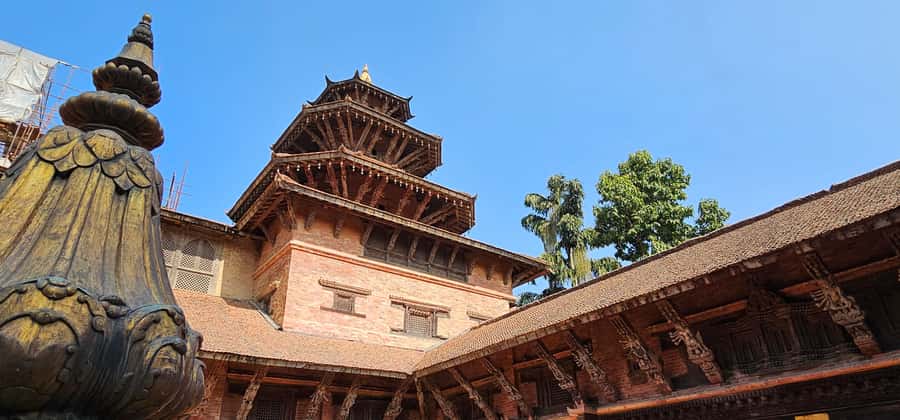
Patan’s former royal palace is organized around three courtyards. Each has its own purpose, and understanding that layout makes the palace visit much more rewarding.
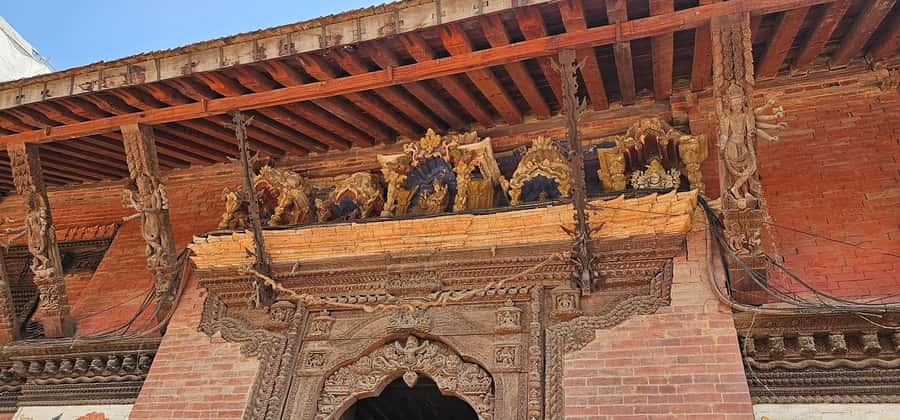
Sundari Chowk, the southern courtyard, was once a royal bath. Its name means beautiful courtyard, and the water fountain is surrounded by carvings of 72 gods and goddesses. The king traditionally offered handfuls of water to favored deities here.
Mul Chowk was the main courtyard and a setting for social and religious occasions. It also contains a temple to Taleju, the tutelary deity of the royal family. This is the place to pay attention to the connection between palace power and religious practice.
Keshav Narayan Chowk contains a small Vishnu temple with images of Vishnu, his wife Lakshmi, and Garuda. This section of the palace was where the king and queen lived. Today it houses a well-preserved museum, giving you a chance to see more than the outside faces of the buildings.
Behind the palace is a former royal garden and the Bhandarkhal Tank. The tank was believed to serve as a store for the palace’s treasure, while its fountain supplied water to the complex. These practical details are easy to miss without explanation, yet they show how a royal compound functioned day to day.
If you have an interest in architecture, religion, or royal life, Patan may be the stronger half of the tour. If you prefer a spacious old town with dramatic squares, Bhaktapur may make the bigger first impression.
The Golden Temple and Patan’s Buddhist side
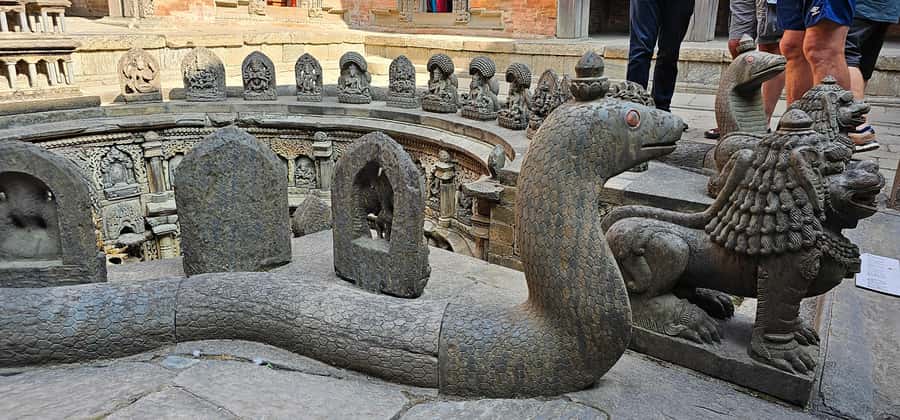
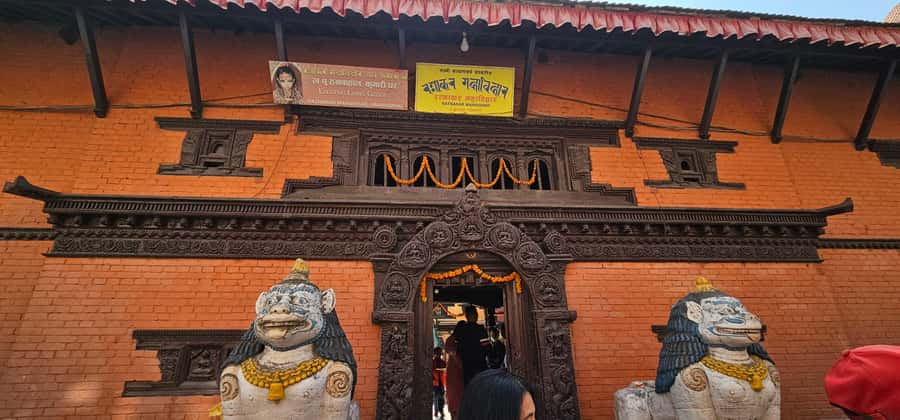
After the palace area, the tour visits Hiranyavarna Mahabihar, better known as the Golden Temple. This is one of Patan’s important Buddhist monasteries and one of its most visually striking stops.
The name is well earned. Metal decoration catches the light across the monastery, showing the skill of Newari metalworkers. Patan is particularly associated with this craft, and the Golden Temple gives you a close look at how religious art can cover an entire working sacred space.
This is not simply another temple on a checklist. The monastery helps balance the Hindu royal and temple sites at Patan with the city’s Buddhist traditions. Take time to look at the details and ask your guide how the monastery fits into local religious life.
The lanes around Patan also offer a chance to see bahals and bahis, the courtyards and monastic spaces that are part of the old city’s structure. Rajendra has been praised for taking visitors beyond the main monuments into side streets where daily life continues. That approach suits Patan, because some of its best atmosphere comes from the links between grand squares and modest residential lanes.
More of Bhaktapur:
- Private Bhaktapur and Nagarkot Day Tour From Kathmandu
★ 5.0 · 305 reviews - Day Trip to Bhaktapur and Panauti from Kathmandu
★ 5.0 · 184 reviews - Bhaktapur & Patan Durbar Square Day Tours
★ 5.0 · 122 reviews - Nagarkot Sunrise & Bhaktapur UNESCO Heritage Private Tour
★ 5.0 · 66 reviews
Bhaktapur’s palace square and medieval streets
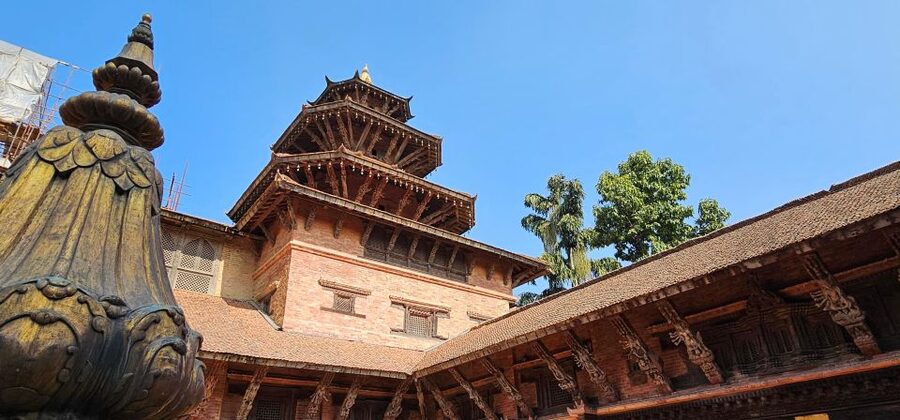
Bhaktapur is the second major stop, with about half a day devoted to walking, guided visits, sightseeing, and free time. Its old center is known for its medieval character, and the open squares make it easier to appreciate the scale of the former kingdom.
The palace square brings together royal buildings, temples, carved windows, and brick architecture. You’ll want comfortable shoes, since this is a walking visit and the most interesting details are spread through the old center rather than gathered in one indoor attraction.
Your guide’s role matters here. Bhaktapur can look simple at first glance, with one square leading to another, but the buildings have different purposes and styles. A good explanation turns a row of carved windows into a lesson in status, craft, and local identity.
The city is especially noted for wood carving. Compare its carved timber with the metal decoration you saw in Patan. This is one of the most useful themes of the day because it gives you something specific to look for instead of treating every temple as another similar monument.
Taumadhi Square and Nyatapola Temple
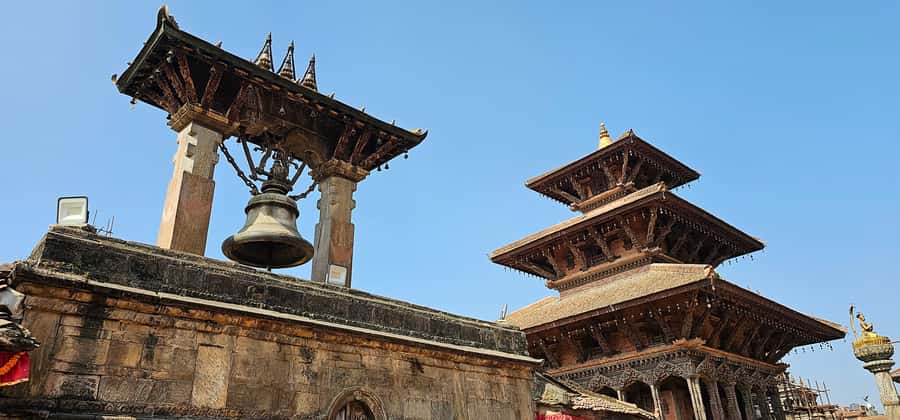
Taumadhi Square, also called Nyatpole Square, is one of Bhaktapur’s most memorable spaces. Its main landmark is Nyatapola Temple, the tallest temple in town.
The temple’s tiered form gives the square a strong vertical focus. From ground level, you can study its steps, guardians, and layered roofline, while from a higher viewpoint you might find a broader view over the surrounding old town. The square is also a good place to pause and absorb the difference between Bhaktapur’s open urban plan and Patan’s tighter courtyards.
A guide can explain the figures and symbols that appear along the approach to the temple. You should allow time for photos here, but do not rush past the surrounding buildings. Taumadhi Square is valuable not only for its tallest temple, but also for the way several religious and civic structures work together as an urban room.
Dattatraya Square and Bhaktapur’s older royal connections
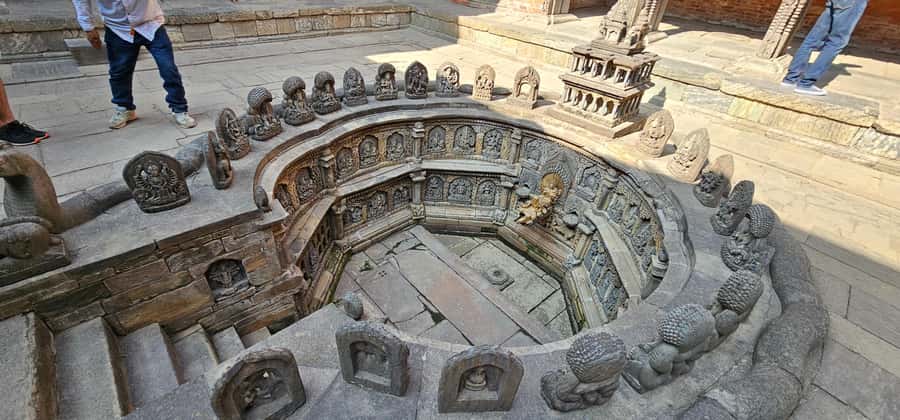
Dattatraya Square is identified as the first square used by Bhaktapur’s royals. That gives the stop a different historical angle from the grand palace area.
The square helps you think about how Bhaktapur grew around royal and religious centers. Its buildings and lanes reflect an older town plan, and a guide can point out details that are easy to miss when you are focused only on the largest temple.
This is also a useful place to ask questions. Siri is praised for allowing plenty of time for conversation, photographs, and shopping, while Rajendra is noted for explaining local customs, clothing, and the skills associated with each city. The private format gives you room to follow those interests instead of moving on at a fixed group pace.
Guides, transport, lunch, and the practical rhythm
Hotel pickup and drop-off in Kathmandu are included, along with an air-conditioned vehicle. That is a real advantage for a six-hour outing, since you can leave the city without arranging separate transport between the two destinations.
The tour offers live guiding in English or Spanish. Siri has been praised for his English and Spanish, humor, organization, and professionalism. Rajendra is especially strong at linking monuments with present-day life, including local dress, side streets, and craft traditions.
The schedule is described as a full-day heritage outing, but the stated duration is six hours. With two cities to cover, expect a focused visit rather than a slow, exhaustive exploration. You will have time for guided sightseeing, free time, walking, questions, and photos, but you should tell your guide early if one place matters most to you.
Lunch is not included, and you can decide when to eat. One meal stop used on the tour has been described as aimed at international visitors. If you want local Nepali food, tell your guide clearly and ask what options are available before stopping.
Monument entrance fees are also extra. At $50 per person, the price is reasonable if you value a private vehicle, a guide, and door-to-door service. It is less attractive if you mainly want transportation and prefer to explore independently. The strongest value comes from the explanations, since the palaces and temples make much more sense when someone points out their symbols, uses, and connections.
The tour allows free cancellation up to 24 hours before departure, and you can reserve now and pay later. Those terms are useful if your Kathmandu plans may change.
Who should book this Patan and Bhaktapur tour?
I would choose this experience if you have one day for the Kathmandu Valley’s major heritage cities and want context instead of a quick photo stop. It suits first-time visitors, architecture fans, photographers, and anyone who wants to connect Nepal’s religious buildings with ordinary city life.
It is also a good fit for couples, families, or friends who value control over the day. You can stop for questions, adjust your pace, take photos, shop, and choose when to eat.
I would hesitate if you want a long, slow visit to every museum and courtyard. Six hours is efficient, but the two cities deserve more time if you have several days in the valley. You should also budget separately for entrance fees and lunch.
Should you book it?
Book this tour if you want a practical introduction to Patan and Bhaktapur without dealing with Kathmandu traffic, directions, and transport on your own. The private format and strong guide feedback are its main advantages.
Choose Siri if language skills and a relaxed, flexible style matter most to you. Choose Rajendra if you want side streets, daily customs, and a closer look at how craft traditions shape each city. Either way, ask for time at the Golden Temple, Patan’s palace courtyards, Nyatapola Temple, and Dattatraya Square.
At $50 per person, this is good value for a concentrated six-hour visit, provided you see the guide and vehicle as part of the experience rather than simply a ride between monuments.
FAQ
Where does the tour begin and end?
Pickup and drop-off are provided at your hotel in Kathmandu.
How long does the tour last?
The stated duration is six hours.
Which places are visited?
The tour visits Patan and Bhaktapur, including Patan Durbar Square, the Golden Temple, Bhaktapur Durbar Square, Taumadhi Square, Nyatapola Temple, and Dattatraya Square.
Is this a private tour?
Yes. The experience is offered for a private group.
Which languages are available?
Live guiding is available in English and Spanish.
Is transport included?
Yes. Hotel pickup and drop-off and air-conditioned transport are included.
Are monument entrance fees included?
No. Monument entrance fees are excluded from the tour price.
Is lunch included?
No. Lunch is not included, although you can decide when you want to have lunch during the day.
What is the cancellation policy?
You can cancel up to 24 hours in advance for a full refund. You can also reserve now and pay later.
More Full-Day in Kathmandu
- Kathmandu: Full Day 7 UNESCO Tour with Lunch – Private/Group
★ 5.0 · 415 reviews - Kathmandu: Full Day Top 4 UNESCO Tour with Lunch – Private/Group
★ 5.0 · 269 reviews - Kathmandu: Full-Day 7 UNESCO Tour with Lunch – Private/Group
★ 4.9 · 247 reviews - Kathmandu: Full Day 7 UNESCO Tour with Lunch – Private/Group
★ 5.0 · 101 reviews
More of Patan
- Kathmandu: Private Patan and Bhaktapur Sightseeing Tour
★ 4.7 · 64 reviews - City tour of Bhaktapur and Patan Durbar Square
★ 4.5 · 20 reviews - Patan Heritage Tour – Private/Small Group
★ 5.0 · 14 reviews - Kathmandu and Patan Heritage and Living Goddess Experience Tour
★ 5.0 · 12 reviews
Recently added around Kathmandu
- Kathmandu Airport Pickup and Drop-off Services★ 5.0 · 3 reviews
- Kathmandu Paragliding★ 5.0 · 3 reviews
- Kathmandu Chandragiri Cable Car and Swayambhunath Private Tour★ 5.0 · 3 reviews
- Explore The Beauty Of Langtang Valley In 8-Days Trek★ 5.0 · 3 reviews
- Kathmandu: Nightlife and Pub Crawl Tour★ 5.0 · 3 reviews
- Kathmandu: Momo Making Class with a Local Chef★ 5.0 · 3 reviews
- Mountain Flight Experience in Nepal★ 4.5 · 3 reviews
- Everest Base Camp Trek★ 5.0 · 3 reviews
Other Bhaktapur Tours worth a look
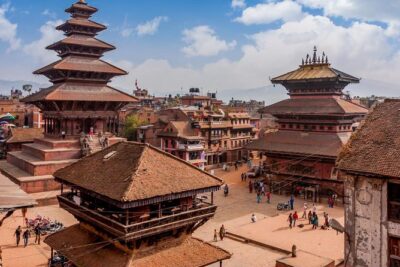
Private Bhaktapur and Nagarkot Day Tour From Kathmandu
Read our review →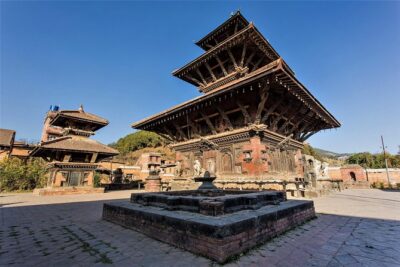
Day Trip to Bhaktapur and Panauti from Kathmandu
Read our review →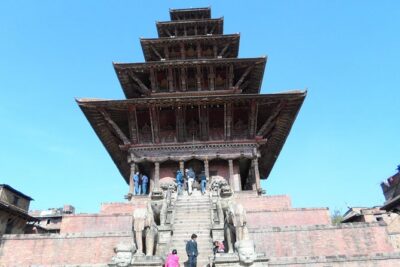
Nagarkot Sunrise & Bhaktapur UNESCO Heritage Private Tour
Read our review →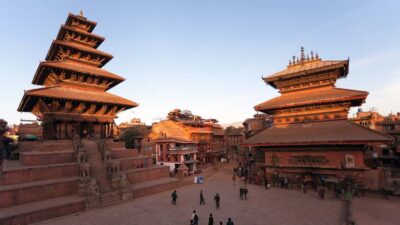
Bhaktapur & Nagarkot Day Tour with Lunch – Private/Group
Read our review →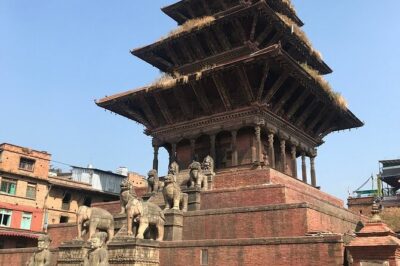
Nagarkot Sunrise & Bhaktapur Heritage Tour -Private Full Day Trip
Read our review →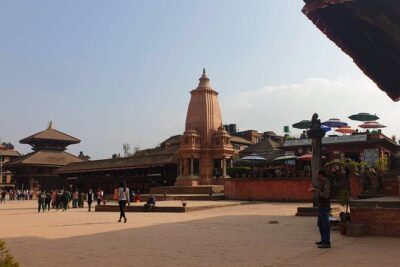
This tour also appears in