
REVIEW · UNESCO HERITAGE SITE TOURS
Private Kathmandu Sightseeing Tour | UNESCO World Heritage sites
Kathmandu’s best sights are spread across the valley, and this private tour gives you a practical way to connect them in one day. You can visit two, four, or seven UNESCO sites, with an English-speaking guide and a private air-conditioned vehicle taking care of the city’s busy roads.
I like the hotel pickup and drop-off, especially if you have just arrived and do not yet know Kathmandu’s streets. I also like the freedom to set the pace: guides such as Dipesh, Shankar, Bidhya, and Prasant have been praised for explaining Hindu and Buddhist customs clearly, adjusting the schedule, and allowing time to wander.
The main tradeoff is simple: the more sites you choose, the more time you spend in the car. Four sites make a sensible introduction for most people. Seven can be rewarding, but it is a long, packed day, and the seven-site entry fee adds considerably to the low tour price.
Key points at a glance
- Choose your scale: Pick two, four, or seven UNESCO sites, with the tour lasting about four to ten hours.
- Start and finish at your hotel: Pickup and drop-off are included for hotels in central Kathmandu.
- Meet Kathmandu’s two great faiths: Pashupatinath explains Hindu worship and cremation customs, while Boudhanath and Swayambhunath show Tibetan Buddhist traditions.
- Go at your own pace: The private format lets you spend longer at a square or shorten a stop that does not hold your interest.
- Expect strong local guidance: Guides including Dipesh, Deepak, Shankar, Bidhya, Mukesh, Razz, and Prasant are noted for history, religion, and cultural explanations.
- Budget for admission: Entry fees are extra, and the seven-site fee may be listed as NPR 5,800 or NPR 6,000, so confirm the current amount before setting out.
Why a private Kathmandu day tour makes sense
Kathmandu is not one compact sightseeing district. Its major monuments are scattered between Kathmandu, Patan, Bhaktapur, and the eastern edge of the valley. Traffic can be slow, directions can be confusing, and several sites make far more sense when someone explains what you are seeing.
That is where this experience earns its keep. At $17 per person, the advertised tour price is modest for private transport, hotel transfers, a guide, and taxes. You still pay monument fees, food, drinks, and tips, but the cost of arranging separate taxis and finding each site would likely be less predictable.
The private format matters most if you are a solo visitor, a couple, or a small family with different interests. You can ask about Buddhism, Hindu ritual, palace design, local life, or Nepal’s mountains without waiting for a large group to catch up.
I would use this as an opening day in Kathmandu. It gives you a map of the valley and helps you decide where to return later. One person described it as a good way to get oriented soon after arrival, and that is exactly how I would view it.
More UNESCO Heritage Site Tours in Kathmandu:
- Kathmandu: Full Day 7 UNESCO Tour with Lunch – Private/Group
★ 5.0 · 415 reviews - Kathmandu: Full Day Top 4 UNESCO Tour with Lunch – Private/Group
★ 5.0 · 269 reviews - UNESCO Seven World Heritage Tour in Kathmandu
★ 5.0 · 253 reviews
Swayambhunath, the hilltop Monkey Temple
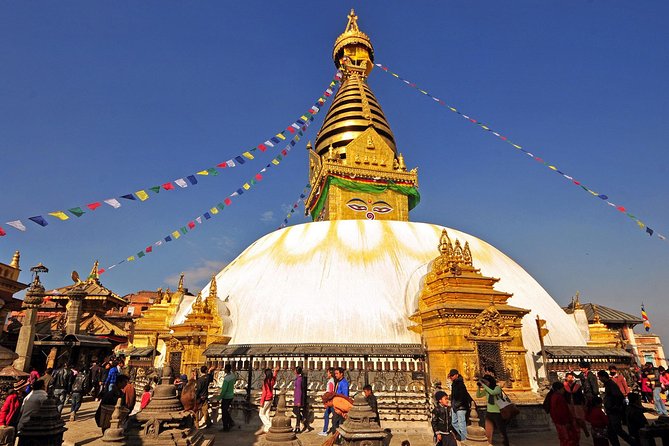
Swayambhunath, often called the Monkey Temple, is a strong first stop. The stupa sits close to Kathmandu and gives you a memorable introduction to the city’s Buddhist side. The site is reached by steps, and the setting combines prayer, pilgrimage, old architecture, and views toward the city.
The itinerary allows about 30 minutes in one version and about an hour in another. That difference matters. Thirty minutes gives you time to see the main stupa and absorb the setting, but an hour is better if you want explanations, photographs, and a slower look at the smaller shrines.
This is one place where a guide can explain details that are easy to miss on your own. You might learn how the stupa’s form relates to Buddhist belief, how people move around it, and why the site remains important for daily worship rather than being only an old monument.
The monkeys are part of the character of the place, but keep your belongings secure and give them space. Admission is not included in the tour price.
Boudhanath Stupa and the rhythm of Buddhist worship
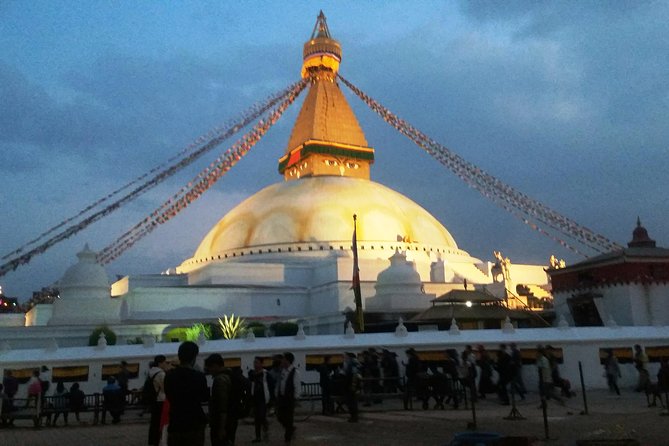
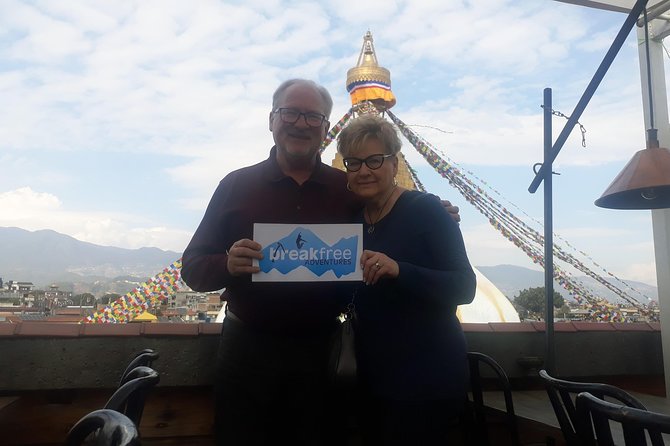
Boudhanath is allotted about an hour, which is a useful amount of time for a first visit. Its huge white dome and watchful eyes create one of Kathmandu’s most recognizable scenes. The surrounding area is a center of Tibetan Buddhist life, with monasteries, shops, rooftop restaurants, and people making ritual circuits around the stupa.
I especially like this stop for visitors who want to see faith as a living part of the city. Your guide can explain the meaning of the stupa and the customs taking place around it, then give you time to walk at your own speed.
A useful tip comes from the way one tour was arranged: lunch at a rooftop café overlooking Boudhanath. A meal is not included, but you can ask your guide for a restaurant suggestion and use the break to enjoy the view. This also helps break up a long sightseeing day.
Boudhanath can be particularly appealing in the evening, when the atmosphere changes and the stupa takes on a calmer glow. If your schedule allows, ask how the order of stops might be adjusted. The exact timing depends on the option you book and the day’s traffic.
Pashupatinath, Nepal’s most important Hindu shrine
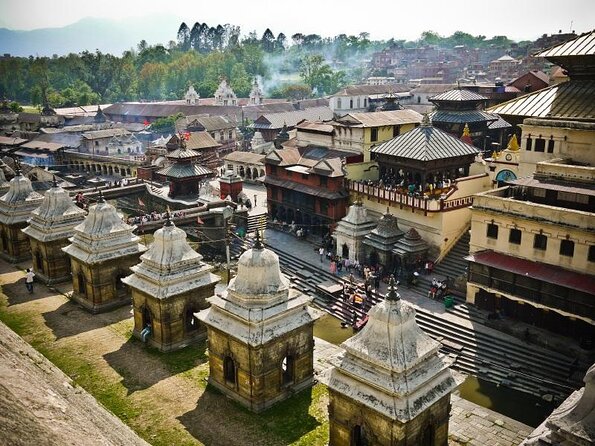
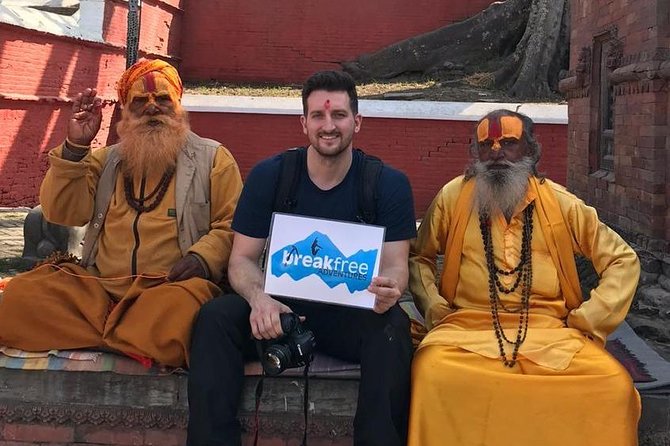
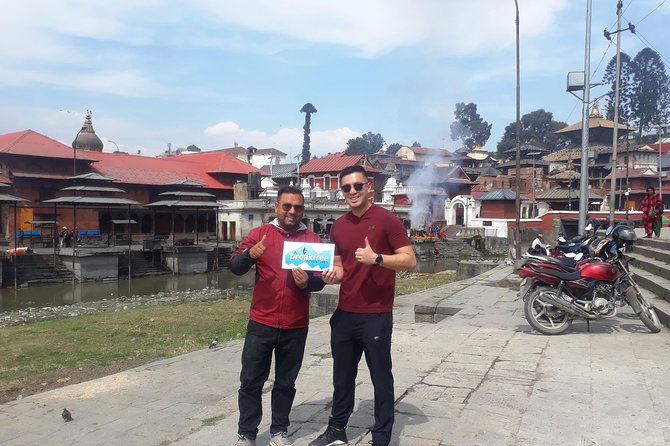
Pashupatinath is one of the tour’s most powerful and sensitive stops. The temple complex sits beside the Bagmati River and is central to Hindu worship in Nepal. You will see temple buildings, shrines, pilgrims, religious figures, and the riverbank cremation area.
The itinerary lists about an hour here, and some versions show the stop twice. Treat that as a scheduling detail rather than two separate attractions. Your guide should clarify how much time is planned at Pashupatinath for your selected option.
This is a place where cultural explanation matters. Hindu rituals can be unfamiliar, and a guide can help you understand what is happening without turning a sacred ceremony into a spectacle. One guide was praised for patiently allowing time to witness a cremation ceremony when one was taking place. If you encounter such a ceremony, observe quietly and follow your guide’s advice about photographs and respectful distance.
There is an important access restriction. Only Nepali and Indian nationals of the Hindu faith may enter the inner premises of the Hindu temples during the tour. You can still see much of the complex and learn about its role, but do not expect to enter every building.
Admission is extra, and this site may feel more intense than the palace squares or Buddhist stupas. I would not rush it.
More Historical Tours in Kathmandu:
- Kathmandu Private Sightseeing Tour | UNESCO World Heritage Sites
★ 5.0 · 109 reviews - Kathmandu: Full Day Private Top 4 UNESCO Heritage Tour W/Lunch.
★ 5.0 · 86 reviews - Kathmandu World Heritage Tour
★ 5.0 · 74 reviews - Nagarkot Sunrise & Bhaktapur UNESCO Heritage Private Tour
★ 5.0 · 66 reviews
Patan Durbar Square and the Patan Museum
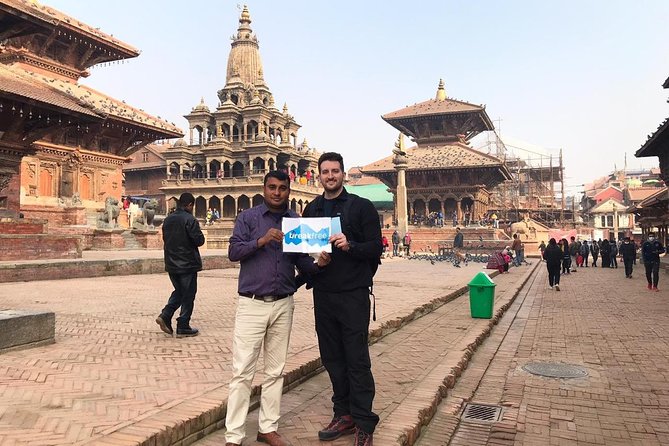
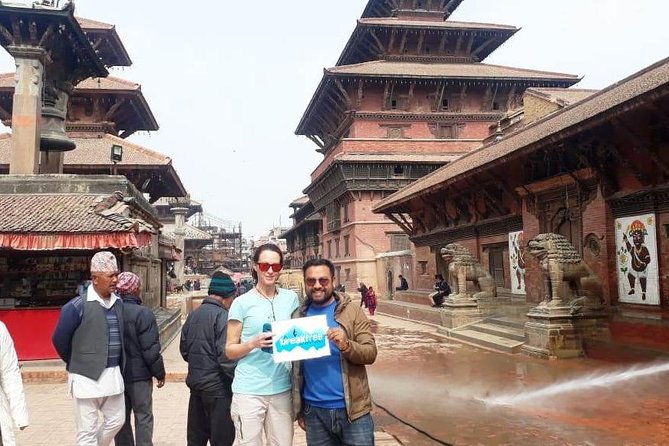
Patan, also known as Lalitpur, gives the tour a different flavor. Its Durbar Square is an old royal center filled with courtyards, temples, carved windows, and palace buildings. The one-hour stop lets you see the main square and understand how art, royal power, and religious life once met in the same space.
The nearby Patan Museum is allotted about 30 minutes. It occupies old palace courtyards and includes areas such as Sundari Chowk. The museum is a useful counterpoint to the open square because it gives more structure to Nepal’s religious art and architectural traditions.
I would give Patan extra attention if you enjoy details. Kathmandu Durbar Square and Bhaktapur are visually dramatic, but Patan rewards a slower look at carved metalwork, timber design, and the relationship between palace courtyards and temples.
The private arrangement helps here. You can ask your guide to explain one carving or icon at length, then spend time exploring alone. Several guides are praised for giving a clear introduction before allowing personal time to wander, which is the right balance at a site like Patan.
Bhaktapur Durbar Square, the longest single stop
Bhaktapur is given about two hours, making it the longest scheduled stop. That is sensible. The old city has several squares, temples, palace courtyards, and lanes, and it is difficult to appreciate it in a quick dash.
This is likely the most rewarding choice for visitors who care about architecture and old-city atmosphere. The brick buildings and carved details create a strong sense of place, while the larger square gives your guide room to explain Nepal’s royal past and religious traditions.
The drawback is distance. Bhaktapur sits farther from central Kathmandu than Swayambhunath, Boudhanath, or Kathmandu Durbar Square. Traffic can affect the time available, especially if you select the seven-site itinerary.
The tour information identifies Bhaktapur Durbar Square as a separate admission site, so budget for another fee. You may want to agree with your guide on a meeting point if you choose to wander through the surrounding city lanes. Since this is a private tour, you can ask to linger here if Bhaktapur becomes your favorite stop.
Changu Narayan, a hilltop temple visit
Changu Narayan is scheduled for about 30 minutes. It is another UNESCO site and gives the full-day route a more distant stop beyond the central city. The temple is important for its age and Hindu religious setting, though the short time means you will get an overview rather than an extended visit.
This stop is best for someone determined to see all seven sites. If you choose the two or four-site option, you may prefer to spend more time at Boudhanath, Pashupatinath, Patan, or Bhaktapur instead.
The road time is the key consideration. A seven-site day links sites across the Kathmandu Valley, so the attraction count looks impressive but does not tell the whole story. You are also paying for transport between them and dealing with Kathmandu traffic.
Kathmandu Durbar Square and the old capital
Kathmandu Durbar Square is another essential stop. The square was the royal center of Kathmandu and brings together temples, palace buildings, courtyards, and reminders of the city’s older political and religious life.
The schedule lists only 30 minutes here, so expect a brisk introduction. If this is your first visit, that may be enough to understand the layout and mark places for a later return. If you like architecture or photography, you may wish to ask whether the schedule can give you more time here by trimming another stop.
The area is close to Thamel, Kathmandu’s main visitor district, with hotels, restaurants, pubs, shops, and tour services. Depending on the arrangement, you might finish near your hotel or in another central area, but confirm the drop-off plan with the guide.
Thamel, Patan Gate, and driving through the valley
Thamel is not presented as a formal monument stop, but it is useful context. It is the main tourist hub, and you will find food, drinks, hotels, shops, and places to arrange other activities. If you are staying there, pickup and drop-off are especially convenient.
Patan Gate marks the entrance to the old city of Patan. It may appear as a brief point of interest rather than a timed visit. These smaller references help you understand that the tour is not only a sequence of ticketed monuments. It also introduces the layout of Kathmandu Valley.
The driving itself is part of the experience, though not always the easy part. One four-site schedule was criticized for involving a lot of time on the road, and that is a fair warning. A private car keeps you comfortable and removes the need to negotiate separate rides, but it cannot eliminate traffic.
Drivers are an important part of the day. Names such as Sajan, Sujan, Ravi, Shyam, and others appear in the tour feedback, with particular praise for calm, safe driving in difficult city conditions. You should still expect slow sections and allow the day to run toward the longer end of the four to ten hour estimate.
Picking two, four, or seven UNESCO sites
The two-site option suits a short stopover, a hot day, or anyone who wants a gentle introduction. It keeps the driving and walking load lower, while still giving you a taste of Kathmandu’s major religious traditions.
The four-site option is the best all-round choice for most people. It offers variety without turning the day into a checklist. A sensible mix might include Swayambhunath, Boudhanath, Pashupatinath, and Patan or Kathmandu Durbar Square, though the exact stops depend on the package.
The seven-site option is for determined sightseers. It can include Swayambhunath, Boudhanath, Pashupatinath, Patan, Changu Narayan, Bhaktapur, and Kathmandu Durbar Square. You will see a great deal, but the day can feel compressed, especially when traffic and admission queues are added.
The tour is private, so you can discuss priorities. Guides have adjusted start times, moved faster for visitors with limited time, added shopping, and even found an extra monastery visit for someone especially interested in Buddhist sites. Do not assume every extra request is guaranteed, but the format gives you room to ask.
Price, entry fees, and what the day really costs
The $17 per-person price is attractive, but it is not the full cost of sightseeing. Monument fees are separate:
- Two UNESCO sites: about NPR 1,400
- Four UNESCO sites: about NPR 2,600
- Seven UNESCO sites: listed as about NPR 5,800 to NPR 6,000
The information gives both NPR 5,800 and NPR 6,000 for seven sites, so confirm the current amount at booking or with your guide. Lower fees may apply to SAARC nationalities.
You also pay for lunch, drinks, personal purchases, and tips. The tour does not include meals, though you can take a lunch break and ask for a recommended restaurant. Water may be supplied, but bring enough for a long day and expect to pay for anything beyond what is provided.
Even with these extras, the tour can be good value if you want a guide and private transport. The main value is not just the car. It is the time saved arranging routes and the cultural background that helps you understand why each temple, stupa, and palace square matters.
Who will get the most from this tour
I would recommend it to first-time visitors, solo visitors, couples, families, and anyone with only one free day in Kathmandu. It is also useful if you prefer a private setting and want to ask questions without holding up a group.
It suits people who enjoy cultural sites more than fast entertainment. You will spend much of the day looking at monuments, hearing explanations, walking courtyards, and watching religious life unfold.
It is less suitable if you dislike sitting in traffic or want a slow, unstructured day. The seven-site option is particularly demanding. If you have limited energy, the four-site choice gives you a better chance to enjoy each place instead of simply collecting entrance tickets.
Wear clothing respectful of religious sites, and remember that access rules apply at Pashupatinath. Comfortable shoes are useful because the route includes steps, courtyards, squares, and uneven historic areas, though the supplied information does not set out specific accessibility details.
Booking advice and final verdict
Book this tour if you want an efficient cultural introduction to Kathmandu and value having a guide explain Hindu and Buddhist traditions. I would choose four sites for the best balance of time, variety, and energy.
Choose two sites if your schedule is short or you have just arrived from a long flight. Choose seven only if seeing every listed UNESCO location matters more to you than lingering over individual places.
The strongest part of the experience is the combination of private transport and flexible guidance. Guides such as Dipesh, Deepak, Shankar, Bidhya, Mukesh, Razz, and Prasant have been singled out for warmth, clear explanations, patience, and the ability to adapt. The main weakness is unavoidable: Kathmandu Valley is spread out, and the road between the sights can take time.
At $17 per person before admissions and meals, this is an inexpensive way to get your bearings fast. Just choose the number of sites honestly. A shorter route enjoyed well is better than a seven-stop race through Kathmandu.
FAQ
How much does the private Kathmandu sightseeing tour cost?
The tour price is $17 per person. Monument admission fees, meals, drinks, personal expenses, and tips are not included.
How long does the tour last?
The experience lasts approximately four to ten hours, depending on the number of UNESCO sites selected and the pace of the day.
Can I choose how many UNESCO sites to visit?
Yes. You can select an option covering two, four, or seven UNESCO sites.
Is hotel pickup included?
Hotel pickup and drop-off are included for hotels in central Kathmandu. Extra charges may apply for locations outside the city center.
Is the tour private?
Yes. Only your own group participates in the activity.
Is transportation included?
Yes. The tour includes private transportation in an air-conditioned vehicle, along with hotel transfers.
Is a guide included?
Yes. A professional English-speaking guide is included. Guides fluent in other languages may be available for an additional charge.
Can I take a lunch break?
Yes. You can take a lunch break during the tour and ask your guide for restaurant recommendations. Food and drinks are not included.
Can all visitors enter Pashupatinath’s inner temple areas?
No. Only Nepali and Indian nationals of the Hindu faith are permitted to enter the inner premises of the Hindu temples during the tour.
Recently added around Kathmandu
- Kathmandu Paragliding★ 5.0 · 3 reviews
- Kathmandu Airport Pickup and Drop-off Services★ 5.0 · 3 reviews
- Kathmandu Chandragiri Cable Car and Swayambhunath Private Tour★ 5.0 · 3 reviews
- Explore The Beauty Of Langtang Valley In 8-Days Trek★ 5.0 · 3 reviews
- Kathmandu: Nightlife and Pub Crawl Tour★ 5.0 · 3 reviews
- Mountain Flight Experience in Nepal★ 4.5 · 3 reviews
- Kathmandu: Momo Making Class with a Local Chef★ 5.0 · 3 reviews
- Everest Base Camp Trek★ 5.0 · 3 reviews
Other UNESCO Heritage Site Tours worth a look
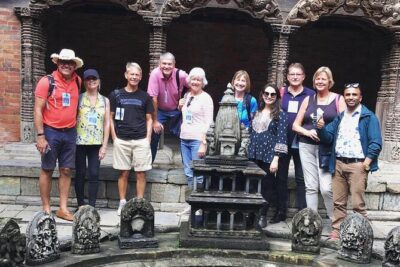
Full Day 7 UNESCO Tour with Lunch – Private/Group
Read our review →
Full Day Top 4 UNESCO Tour with Lunch – Private/Group
Read our review →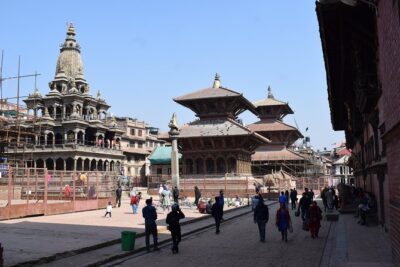
Full-Day 7 UNESCO Tour with Lunch – Private/Group
Read our review →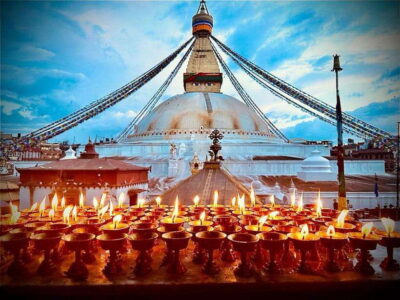
Kathmandu Private Sightseeing Tour | UNESCO World Heritage Sites
Read our review →Full Day 7 UNESCO Tour with Lunch – Private/Group
Read our review →This tour also appears in