
REVIEW · UNESCO HERITAGE SITE TOURS
UNESCO Five World Heritage Tour in Kathmandu
Kathmandu’s finest cultural sights are packed into one demanding but rewarding day, from the hilltop eyes of Swayambhunath to the prayer wheels of Boudhanath and the riverside shrines of Pashupatinath. In between, you walk through two old royal cities filled with carved windows, courtyards, temples, and living religious practice.
I like two things right away: private transport saves you from haggling with taxis, and every listed heritage-site entry fee is included. Guides such as Shanti, Sarita, Tej, and Rabina are repeatedly praised for clear explanations and patient service.
The trade-off is simple: this is a lot of Kathmandu in one day. The schedule gives you a strong first look, but several stops receive only five to fifteen minutes, and the full day can feel rushed if you want time for quiet observation, shopping, or museum displays.
Key points before you book
- Five major UNESCO areas in one day: Visit Swayambhunath, Kathmandu Durbar Square, Patan Durbar Square, Pashupatinath, and Boudhanath.
- Private car and guide: Your group travels together, with hotel pickup and drop-off inside Kathmandu’s Ring Road, including the Bouddha area.
- Hindu and Buddhist traditions together: The route shows how closely both faiths shape Kathmandu Valley life.
- Strong guide service: Shanti, Sarita, Tej, and Rabina are named for their clear teaching, flexibility, and friendly manner.
- Entry fees included: You do not need to handle admission payments at the heritage sites.
- A packed cultural day: The advertised duration is about seven to eight hours, though the schedule may stretch when traffic, questions, or extra time at a site enter the picture.
Why this Kathmandu day tour works
The best reason to choose this outing is coverage. You see the valley’s main cultural centers without spending the day arranging separate taxis, checking opening details, or trying to work out which square belongs to which old kingdom.
The route also gives you useful contrast. Kathmandu Durbar Square and Patan Durbar Square are former royal centers shaped by Newar artists and builders. Swayambhunath and Boudhanath show two different expressions of Buddhism. Pashupatinath brings you into Nepal’s most important Hindu temple complex, though access and viewing conditions differ from the Buddhist sites.
A private tour matters here. Kathmandu’s sights are spread across the city, and moving between them by hired taxi can mean repeated bargaining and uncertainty. A private car lets you leave when your time is up and gives your guide a chance to adjust the order or explain what you are seeing along the way.
The guide is the heart of the experience. Shanti Karki is singled out for her professionalism, warmth, detailed explanations, and ability to keep the day comfortable. Sarita is described as a scholar of Nepali history who can handle detailed questions. Tej is praised for explaining how religion and culture developed in Nepal. Rabina is noted for flexibility, including giving a solo visitor time to shop.
You should still set realistic expectations. This is an overview, not a slow architectural study. The attraction is the range of places covered. The cost is the limited time at some of them.
More UNESCO Heritage Site Tours in Kathmandu:
- Private Kathmandu Sightseeing Tour | UNESCO World Heritage sites
★ 5.0 · 756 reviews - Kathmandu: Full Day 7 UNESCO Tour with Lunch – Private/Group
★ 5.0 · 415 reviews - Kathmandu: Full Day Top 4 UNESCO Tour with Lunch – Private/Group
★ 5.0 · 269 reviews
Swayambhunath, Kathmandu’s hilltop symbol
Your first stop is Swayambhunath Stupa, often called the Monkey Temple. The supplied schedule allows about an hour, enough to take in the stupa, its religious importance, and the hilltop setting.
This is a particularly useful opening because Swayambhunath matters to both Buddhist and Hindu communities. Your guide can help you read the symbols and explain why the site belongs in a tour centered on Kathmandu’s shared religious culture.
The hill location gives the site a strong sense of place, though the visit is not just about a view. Prayer activity, shrines, and the stupa itself make this a working sacred site rather than a museum piece. You should dress respectfully and expect a setting where worship continues around you.
Amideva Buddha Park and the first short stop
A brief fifteen-minute visit follows at Amideva Buddha Park, near the hill where Swayambhunath sits. Three large statues of Shakyamuni Buddha give the small park a calm, visual pause after the larger temple complex.
Do not expect a major attraction requiring a long visit. Its value is in the contrast: Swayambhunath can feel full of symbols and movement, while the park offers a quick look at monumental Buddhist sculpture in an open setting.
The short stop also shows how tightly packed the day is. If you enjoy photography or want time to sit, you may find fifteen minutes goes quickly.
Kathmandu Durbar Square and the old royal center
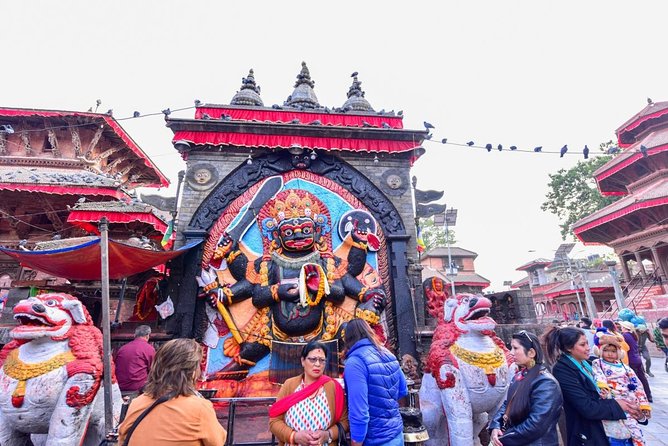
Kathmandu Durbar Square receives about an hour, followed by separate visits to Basantapur Tower, Degu Taleju Temple, Kumari Chowk, and Kaal Bhairab. Together, these stops form one of the day’s major sections.
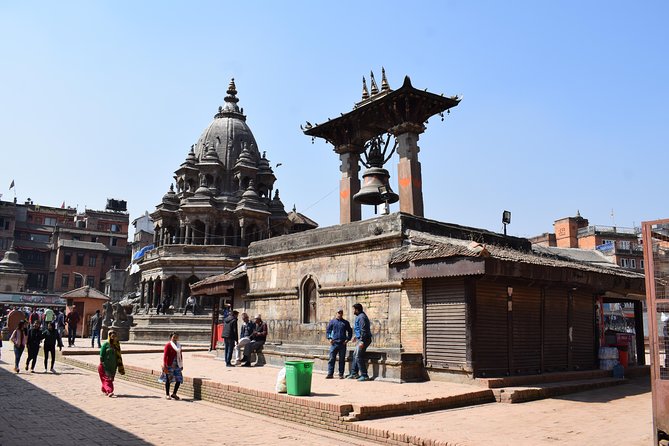
The square is a former royal center filled with religious buildings and historic structures. Some buildings are still being rebuilt, so you will see a place shaped by both age and ongoing repair. Your guide can explain the importance of the buildings rather than leaving you to sort out the many similar-looking courtyards and temples.
Basantapur Tower gets thirty minutes. It is one of the square’s attractive points and gives you time to appreciate the arrangement of the old palace area.
Degu Taleju Temple receives ten minutes. Built in 1564, it adds a precise date and a clear example of the valley’s temple tradition to the wider story.
At Kumari Chowk, you enter the courtyard connected with the Kumari, the living goddess of Kathmandu. A girl is selected for this role and remains the Kumari until puberty, after which she returns to ordinary life. The schedule gives you ten minutes here, and one account describes the rare good fortune of seeing the Kumari. That possibility should be treated as luck, not as a guaranteed part of the visit.
Kaal Bhairab is a five-minute stop for the statue of Bhairav, a fierce form associated with Shiva. It is quick, but it adds another layer to the religious world of the square.
The main limitation is time. Kathmandu Durbar Square has enough detail for several hours, yet this tour divides it into short, guided views. I would stay close to your guide and ask questions as you go, since you may not have time to return to individual buildings later.
More Historical Tours in Kathmandu:
- UNESCO Seven World Heritage Tour in Kathmandu
★ 5.0 · 253 reviews - Kathmandu Private Sightseeing Tour | UNESCO World Heritage Sites
★ 5.0 · 109 reviews - Kathmandu: Full Day Private Top 4 UNESCO Heritage Tour W/Lunch.
★ 5.0 · 86 reviews - Kathmandu World Heritage Tour
★ 5.0 · 74 reviews
Patan Royal Palace and Newar craftsmanship
Patan, now part of Lalitpur, is the most extended architectural section of the day. The royal palace area receives about an hour, with separate time for Patan Durbar Square, Taleju Mandir, Patan Museum, the Golden Temple, Vishwanath Mandir, and Bhimsen Temple.
Patan’s importance comes from its Newar architecture and artistic detail. Look for carved windows, wooden pillars, metal images, and carefully arranged temple courtyards. The old palace area brings together royal, Hindu, and Buddhist traditions in a compact space.
Patan Durbar Square gets about forty-five minutes. This former royal courtyard is known for temples and artwork created by the Newar community. The buildings are not simply decorative. They show the skill of the valley’s traditional craftsmen and the close connection between political power and religious life.
Taleju Mandir was rebuilt by Srinivasa Malla after a fire in 1676. A short fifteen-minute look is enough for an introduction, but not for a long architectural reading.
Patan Museum receives fifteen minutes. This is one stop where the time limit matters most. Inside, you can see old statues, carved windows, and wooden pillars. If museum collections are a major reason for your visit, ask your guide at the start of the day if the timetable can give this section extra attention.
The Golden Temple, or Hiranya Varna Mahavihar, is a twelfth-century pagoda-style temple decorated with golden and silver details and bronze statues. It is a small but memorable stop, with ten minutes scheduled.
Vishwanath Mandir, built during the reign of Siddhi Narsingh Malla and dedicated to Shiva, receives five minutes. Bhimsen Temple receives fifteen minutes. The latter was built in 1680 by Srinivasa Malla and is worshiped by the Newar community as a god of business and trade.
Patan rewards close attention. The route moves quickly, but the guide’s explanations help you connect a temple’s name, date, patron, and religious purpose. I would not treat this as a photo-only stop. Pause long enough to notice the metalwork and wood carving that make Patan different from Kathmandu’s royal square.
Pashupatinath and a major Hindu sacred complex
Pashupatinath receives about an hour and changes the tone of the day. This is a Hindu temple complex with more than 500 shrines and temples, and it is the principal temple for devotees of Shiva.
You will see pagoda-style structures and a large sacred complex rather than one isolated building. The site is important for religious reasons first, so respectful behavior matters. Follow your guide’s instructions about where to stand, what you may enter, and how to photograph.
Pashupatinath is also a good place to understand that heritage in Kathmandu is not frozen behind glass. People come here to worship, perform rituals, and maintain a living tradition. That can make the visit more meaningful, but it also means the experience may vary according to religious activity and access conditions.
An hour provides a useful introduction. It does not allow you to inspect more than a fraction of the complex. Stay attentive to your guide’s explanation and avoid treating sacred activity as a spectacle.
Boudhanath and the final Buddhist panorama
The day ends at Boudhanath Stupa, with about an hour to explore. The large dome-shaped stupa is described as 36 meters high and is surrounded by prayer wheels and Buddhist images.
Boudhanath gives you a very different Buddhist setting from Swayambhunath. The scale is larger and the surrounding religious features make it easy to understand the stupa as a place of repeated prayer and ritual movement. You have enough time here to walk around, look at the structure from different angles, and ask your guide about the symbols.
Ending at Boudhanath works well because it leaves you with a clear visual picture of Kathmandu’s Buddhist tradition. It also brings the day back to the theme introduced at Swayambhunath: Nepal’s religious life is varied, layered, and shared across communities.
The hour can still pass quickly. If you want a slow circuit around the stupa or time for shopping, tell your guide early. The day has many fixed stops, so extra time in one place has to come from somewhere else.
What the $130 price includes
At $130 per person, the value depends on how much you would otherwise spend on transport, admission, and arranging a full day of sightseeing. The price includes a private car, a professional guide, hotel pickup and drop-off within the Ring Road, and entry fees for all the heritage sites listed.
For a solo visitor, the price is higher per person than it would be for a small private group, but the convenience is significant. You are not paying for a large coach circuit, and the whole group can ask questions and set the pace within the day’s limits.
Food and drinks are not included. Plan for that separately, since the published tour time covers a full day of sightseeing. Group discounts are offered, so the price becomes more attractive when two or more people share the private vehicle.
The included admissions also make budgeting easier. Kathmandu’s squares, museums, temples, and stupas can involve several separate payments. Having those handled in the tour price removes small delays and the need to carry exact amounts at every stop.
Timing, pickup, and the pace of the day
The start time is 9:00 am. Pickup is offered from hotels inside Kathmandu’s Ring Road, including the Bouddha area. Drop-off is included in the same stated service area.
The advertised duration is approximately seven to eight hours. With sixteen listed stops, that is a quick pace. Some locations receive an hour, while others receive five, ten, or fifteen minutes.
One useful point from the tour’s operating notes is that the day may run much longer in practice, with a full heritage schedule taking up to about twelve hours in some cases. I would keep your evening flexible, especially if you want to ask questions, shop, or spend longer at Patan Museum or Boudhanath.
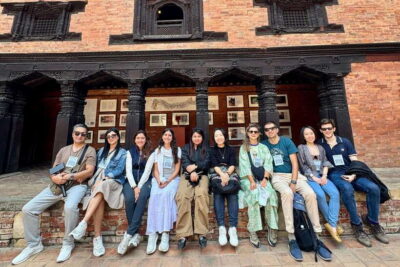
This is a private activity, so only your group participates. That is valuable for a first day in Kathmandu, for solo visitors, and for anyone who prefers to ask basic questions without holding up a larger party.
Which visitors will get the most from it
I would choose this tour if you have limited time in Kathmandu and want a broad cultural introduction in one day. It suits people interested in architecture, royal history, Hindu worship, Buddhist practice, and traditional Newar art.
It is also a strong choice if you dislike negotiating with taxi drivers or organizing several separate admissions. The private car and guide remove much of the day’s practical friction.
You may want a slower, more specialized plan if you are an architecture student, serious photographer, museum enthusiast, or repeat visitor. The route gives you access to many major sites, but the schedule leaves little room for lingering.
Solo visitors can benefit from the personal guidance. A private guide can explain unfamiliar symbols, answer questions, and allow some flexibility. The day is also suitable for a small group, particularly because group discounts are available.
Booking and cancellation details
Confirmation is received at the time of booking, and most people can participate. The experience has a five-star rating with all listed recommendations positive, but the main point for your decision is the format: this is a private, full-day sightseeing service rather than a relaxed walk through one historic quarter.
Free cancellation is available when you cancel at least 24 hours before the start time. Cancellations or changes made within 24 hours are not refunded or accepted, and the cut-off follows local time.
My recommendation
Book this UNESCO heritage day if you want to see the main cultural sights of Kathmandu quickly and prefer a private car with a guide who can explain what you are seeing. The strongest reason to choose it is the combination of range, included entry fees, and guides such as Shanti, Sarita, Tej, and Rabina, who bring structure to a complicated day.
Skip it if your priority is slow exploration. You will not have unlimited time at every temple, and food and drinks are extra. For a first visit or a short stay, though, this is a practical way to connect Kathmandu’s royal squares, Hindu sanctuaries, Buddhist stupas, and Newar craftsmanship in one well-filled day.
FAQ
What is included in the UNESCO Five World Heritage Tour in Kathmandu?
The tour includes transport by private car, a professional tour guide, entry fees for all listed heritage sites, and hotel pickup and drop-off inside Kathmandu’s Ring Road, including the Bouddha area.
How long does the tour last?
The stated duration is approximately seven to eight hours. The complete schedule can sometimes take longer, with operating information noting that a full heritage day may extend toward twelve hours.
What time does the tour start?
The meeting and start time is 9:00 am.
Is hotel pickup available?
Yes. Hotel pickup and drop-off are available inside the Ring Road area, including the Bouddha area.
Is this a private tour?
Yes. Only your group participates in the activity.
Which major sites are visited?
The route includes Swayambhunath, Amideva Buddha Park, Kathmandu Durbar Square, Basantapur Tower, Degu Taleju Temple, Kumari Chowk, Kaal Bhairab, Patan Royal Palace, Patan Durbar Square, Taleju Mandir Temple, Patan Museum, the Golden Temple, Vishwanath Mandir Temple, Bhimsen Temple, Pashupatinath Temple, and Boudhanath Stupa.
Are food and drinks included?
No. Food and drinks are not included in the tour price.
What is the cancellation policy?
You can cancel at least 24 hours before the start time for a full refund. Cancellations or changes made less than 24 hours before the experience are not accepted and are not refunded.
Recently added around Kathmandu
- Kathmandu Paragliding★ 5.0 · 3 reviews
- Kathmandu Airport Pickup and Drop-off Services★ 5.0 · 3 reviews
- Kathmandu Chandragiri Cable Car and Swayambhunath Private Tour★ 5.0 · 3 reviews
- Explore The Beauty Of Langtang Valley In 8-Days Trek★ 5.0 · 3 reviews
- Kathmandu: Nightlife and Pub Crawl Tour★ 5.0 · 3 reviews
- Mountain Flight Experience in Nepal★ 4.5 · 3 reviews
- Kathmandu: Momo Making Class with a Local Chef★ 5.0 · 3 reviews
- Everest Base Camp Trek★ 5.0 · 3 reviews
Other UNESCO Heritage Site Tours worth a look

Private Kathmandu Sightseeing Tour | UNESCO World Heritage sites
Read our review →
Full Day 7 UNESCO Tour with Lunch – Private/Group
Read our review →
Full Day Top 4 UNESCO Tour with Lunch – Private/Group
Read our review →
Full-Day 7 UNESCO Tour with Lunch – Private/Group
Read our review →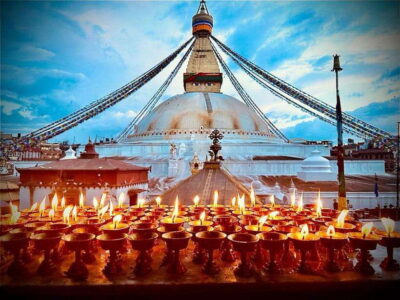
Kathmandu Private Sightseeing Tour | UNESCO World Heritage Sites
Read our review →This tour also appears in