
REVIEW · KATHMANDU TOURS
Kathmandu City Tour
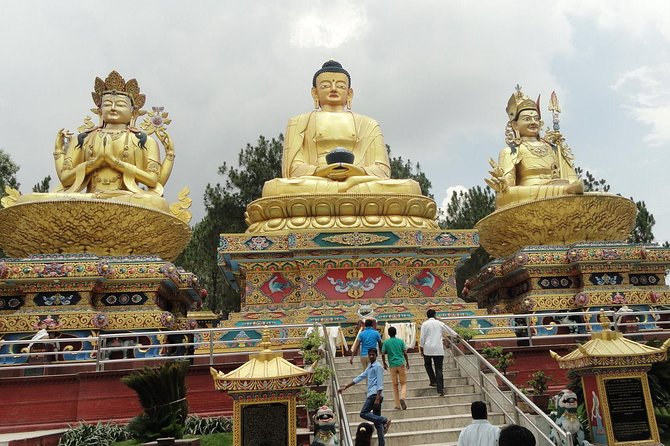
Kathmandu’s best-known sights are spread across a crowded valley, and this private day tour links four of them without making you work out the transport yourself. You’ll visit Hindu shrines, Buddhist monuments, royal squares, and the hilltop Swayambhunath, often called the Monkey Temple. Pashupatinath and Bouddhanath give the day its strongest spiritual focus.
I like the private format, since your group can travel at its own pace instead of waiting for a bus full of strangers. I also like the practical setup: an air-conditioned vehicle, hotel pickup, and a guide are included. The main drawback is cost. At $100 per person, it is most attractive for a small group that values convenience, not for a solo visitor trying to keep expenses low. Lunch, drinks, and heritage-site permits are not included.
Four Kathmandu sights, one long day
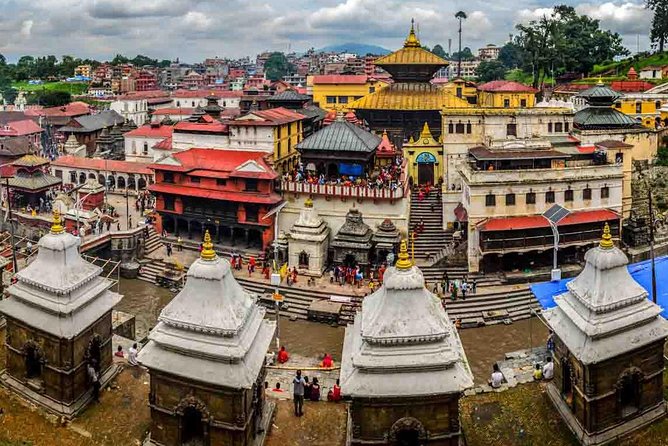
- Pashupatinath Temple: Kathmandu’s most important Hindu temple complex, set along the Bagmati River.
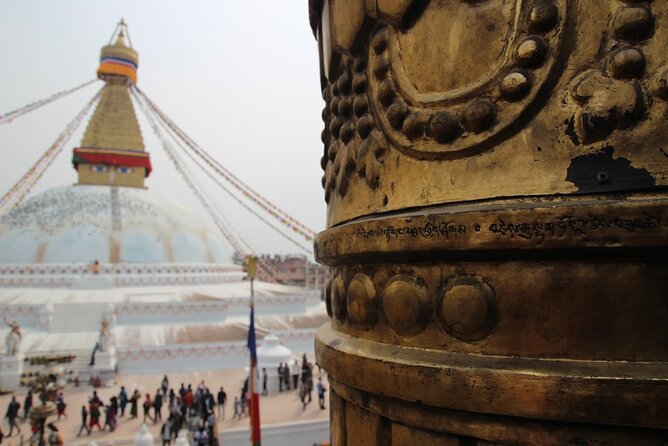
- Bouddhanath Stupa: One of the city’s great Buddhist landmarks, with prayer flags, shrines, and a wide circular base.
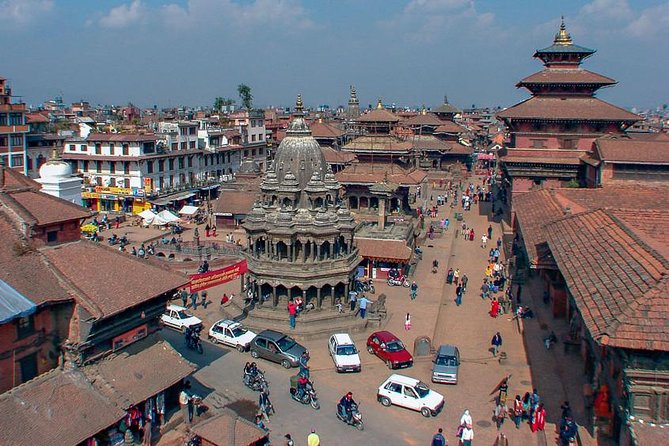
- Patan Durbar Square: A royal quarter filled with Newari woodcarving, brick courtyards, and temple architecture.
- Swayambhunath Stupa: A hilltop Buddhist site with city views and the monkeys that give the place its nickname.
- Private transport: An air-conditioned vehicle and hotel pickup help you cover a wide area in about seven hours.
- Flexible human contact: The company has used staff such as driver Kiran and organizers Kumar and Madan on its Nepal trips, so you can ask who will lead your specific outing.
Why this tour works for a first day in Kathmandu
Kathmandu Valley is not one compact old town. Its major monuments sit in different parts of the valley, and traffic can make short distances take time. This route gives you a useful first look at the city’s main religious and royal centers in a single outing.
You start at about 8:15 a.m. and spend roughly seven hours on the road and at the sights. That early start matters. It gives you a better chance of reaching the first stop before the day feels too hot or the roads become even slower.
The tour is private, so only your group participates. That is useful if you want to pause for photographs, ask questions, or adjust the rhythm of the day. It also means you should speak up if you need a shorter visit at one site and more time at another.
The guide is central to the experience. Kathmandu’s temples can look confusing at first, with shrines, courtyards, statues, rituals, and old palace buildings packed together. A good guide can explain what you are seeing instead of leaving you with a string of attractive but unexplained views.
Past arrangements with Himalayan Hero Adventures have included drivers such as Kiran, noted for good English and confident driving, and organizers named Kumar and Madan. Your booking may have a different guide or driver, so ask for the names and language ability in advance if that matters to you.
More City Tours in Kathmandu
- Kathmandu: Private City Guided Tour
★ 4.9 · 174 reviews - Kathmandu Valley City Day Tour
★ 5.0 · 40 reviews - Full Day Kathmandu City Sightseeing Tour of UNESCO Heritage Sites
★ 5.0 · 36 reviews
Pashupatinath Temple and the Bagmati River
Pashupatinath is the day’s strongest introduction to living Hindu practice. It is not simply an old monument for photographs. It is a major temple complex with an active religious role, and that changes how you should approach it.
The main temple is dedicated to Shiva and is especially important to Hindus. Access rules can vary by area and religious identity, so you should follow your guide’s instructions and observe respectfully. Even where you cannot enter, the surrounding complex offers plenty to see.
The Bagmati River runs beside the site. Its ghats and riverside activity give Pashupatinath a serious, sometimes intense atmosphere. This is a place where daily religious customs are visible, so keep your camera use discreet and do not treat ceremonies as a performance staged for visitors.
I would give this stop time for observation rather than rushing from one shrine to the next. Look at the carved details, small shrines, painted figures, and the way worshippers move through the complex. The guide can help separate the main temple from the many smaller sacred spaces around it.
The practical caution is that Pashupatinath may feel crowded and visually overwhelming. If you prefer quiet ruins, this is not that kind of stop. It is valuable precisely because it remains part of Kathmandu’s working religious life.
Bouddhanath Stupa and the Buddhist circuit
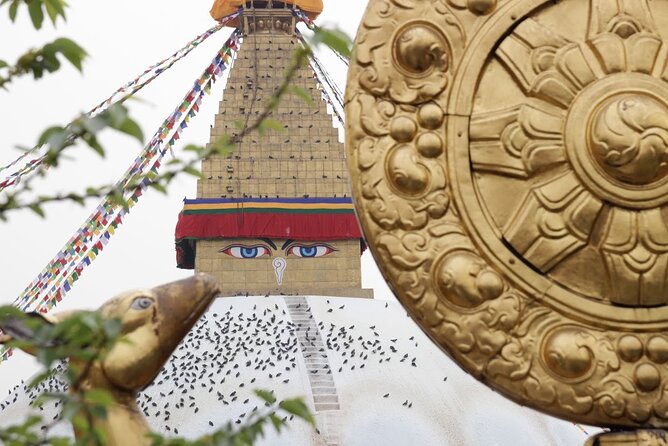
Bouddhanath, also spelled Boudhanath, brings a different mood. The great white stupa rises above a broad circular base, with the Buddha’s watchful eyes painted on its tower. Prayer flags and Buddhist shrines surround the monument.
The usual way to appreciate the stupa is to walk around it in a clockwise direction. Your guide should explain the meaning of the prayer wheels, images, and ritual movement. Even a short circuit gives you a sense of how the monument functions as a place of prayer, not just a famous photo stop.
Look up as you walk. The stupa’s white dome, square tower, painted eyes, and gilded upper levels are best understood as one symbolic design. Then look closer at the smaller shrines and decorative details around the base.
Bouddhanath is also a useful place to see the Tibetan Buddhist influence in Kathmandu. The setting connects the valley with a wider Himalayan religious world. You may find shops and eating places around the circle, but the tour price does not include lunch, coffee, or tea, so plan your spending accordingly.
I like the contrast between Bouddhanath and Pashupatinath. One is shaped around a Hindu temple and riverside rites; the other centers on a Buddhist stupa and a circular walking route. Seeing both in the same morning or afternoon gives the tour a clear cultural range.
Patan Durbar Square and Newari craftsmanship
Patan Durbar Square is the most rewarding stop for architecture. Patan, also known as Lalitpur, was once a separate royal center, and its palace courtyards and temples show the skill of the Newar builders and artists who shaped Kathmandu Valley.
Expect brick courtyards, carved wooden windows, tiered pagodas, stone statues, and metalwork. The square is not one single building. It is a cluster of connected spaces, each with its own shrine, palace frontage, or carved detail.
This is where a guide can add real value. Without help, you might notice that the buildings are beautiful but miss the difference between a palace courtyard, a temple entrance, and a shrine used for local worship. Ask about the carvings and the purpose of each courtyard rather than only asking for names.
Patan is also a good place to slow down after the first two religious sites. The buildings reward close looking. Notice the deep shadows beneath the pagoda roofs, the small figures carved into timber, and the way the square is arranged around open space.
The tour description says heritage-site permits are not included. That is an important price detail. Confirm the current permit or admission charges before you set out, since the $100 fee covers the vehicle and guide but not every possible site cost.
Patan Durbar Square can be a highlight for anyone interested in architecture, photography, or traditional craft. If your main goal is mountain scenery, though, this city tour is not designed for that. It is about the valley’s buildings, beliefs, and urban culture.
A few more Kathmandu days to weigh up
- Everest Base Camp Trek – 14 Days
★ 5.0 · 1,499 reviews - Private Kathmandu Sightseeing Tour | UNESCO World Heritage sites
★ 5.0 · 756 reviews - Everest Base Camp Helicopter Tour landing at Everest View Hotel
★ 5.0 · 668 reviews - Half day cooking class in Thamel kathmandu
★ 5.0 · 607 reviews
Swayambhunath, the hilltop Monkey Temple
Swayambhunath gives the day a change of scale. The stupa sits on a hill above Kathmandu, and the climb or approach brings wider views across the city. The site is also known as the Monkey Temple because monkeys are a familiar part of the grounds.
The stupa itself carries the same visual language of eyes, prayer flags, and Buddhist symbolism that you see at Bouddhanath, but the hilltop setting makes the experience different. You can study the monument and then look outward over Kathmandu Valley.
Take care around food and loose belongings near the monkeys. They are part of the site’s character, but they are still wild animals. Follow the guide’s advice and avoid reaching toward them.
Swayambhunath can be tiring late in the day, especially if you have already spent hours walking through the other sites. Ask how much climbing is involved for the route your group will take. The tour is suitable for most participants according to the supplied information, but that does not mean every visitor will find the steps easy.
I like ending here because it leaves you with a broad view after several close-up visits. You move from courtyards and shrine details to a hilltop perspective of the city. It is a fitting final stop, provided traffic and site timing do not force a rushed visit.
What the $100 price really covers
The cost is $100 per person. Its value depends heavily on your group size and how much you care about private transport.
You receive an air-conditioned vehicle and a tour guide. Pickup is offered, and the activity is private, so your group does not share the day with other participants. Those features can save time and reduce the stress of negotiating Kathmandu’s roads and finding each site independently.
For a couple, family, or small group, the price may feel reasonable because you are paying for a full day of transport, planning, and explanation. For one person, the per-person rate is harder to justify unless you place a high value on convenience or have limited time in Kathmandu.
You need to budget extra for lunch, coffee or tea, and permits at heritage sites. The supplied information does not give the exact permit price, so ask before booking. That one question will give you a more honest total cost.
Group discounts are available, which makes the tour more appealing for larger parties. Ask how the discount applies and whether the vehicle size changes with your group. The tour includes a mobile ticket, and booking confirmation is provided at the time of booking.
Timing, transport, and the pace of the day
The listed start time is 8:15 a.m., with a total duration of about seven to eight hours. That is enough time to see the four main sites, but it is not an invitation to linger for hours at each one.
Kathmandu traffic is part of the practical calculation. The sites are located in different parts of the valley, and the air-conditioned vehicle is more than a comfort feature. It gives you a private place to rest between stops and avoids the uncertainty of piecing together public transport.
The tour is near public transportation, but that does not mean public transport is included or that it will be the easiest choice for this route. If you are already staying near a central area, confirm the pickup point and expected return details when you book.
A flexible private schedule is useful. One past booking arrangement allowed the pickup time to be adjusted to suit the group, but the stated start time for this experience is 8:15 a.m. Treat that as the standard and request any change ahead of time rather than assuming it will be possible.
Who should book this Kathmandu day tour
I would recommend it to a first-time visitor who wants the main heritage sights handled in one day. It also suits families, couples, and small groups that prefer a private car and a guide to independent sightseeing.
It is a good match if you want both Hindu and Buddhist sites, along with royal architecture. The four stops are varied enough to keep the day from feeling repetitive.
You may want a different plan if you prefer a slow, wandering day in one neighborhood. Four major sites in seven hours means movement and structure. You should also think twice if your budget is tight or if you would rather spend the day in local markets, cafés, or smaller courtyards.
Past service details point to a friendly, practical style. The company has arranged comfortable cars, English-speaking drivers, local food stops, and even tailor-made schedules for some visitors. Those extras are not guaranteed as part of this exact itinerary, so ask if you want a market stop, a lunch recommendation, or a different pickup time.
Booking details and cancellation
Free cancellation is allowed up to 24 hours before the experience begins, based on local time. Cancel at least 24 hours ahead for a full refund.
Cancellations or changes made within 24 hours are not accepted and are not refunded. Confirmation arrives when you book, and mobile tickets are available.
Should you book it?
Book this tour if you want an efficient first look at Kathmandu’s major religious and royal sites, especially with a private vehicle and guide. The strongest reasons are the four-stop route, hotel pickup, air-conditioned transport, and the chance to ask questions throughout the day.
The $100 price is fair for a small group that values ease, but less attractive for a solo budget visitor. Before paying, confirm the guide’s name, pickup point, heritage permits, and whether your group can make small timing changes. If those details suit you, this is a sensible way to get your bearings in Kathmandu without spending your first day sorting out transport.
FAQ
How long does the Kathmandu City Tour last?
The tour lasts approximately seven to eight hours. The itinerary itself lists about seven hours.
What time does the tour start?
The stated start time is 8:15 a.m.
Is the tour private?
Yes. Only your group participates in the activity.
What places are included?
The tour visits Pashupatinath Temple, Bouddhanath Stupa, Patan Durbar Square, and Swayambhunath Stupa, also called the Monkey Temple.
Is hotel pickup available?
Pickup is offered. Confirm the exact pickup point when booking.
Is transportation included?
Yes. An air-conditioned vehicle is included.
Is a guide included?
Yes. A tour guide is included.
Are lunch and heritage permits included?
No. Lunch, coffee, tea, and permits at heritage sites are not included in the tour price.
Recently added around Kathmandu
- Kathmandu Paragliding★ 5.0 · 3 reviews
- Kathmandu Airport Pickup and Drop-off Services★ 5.0 · 3 reviews
- Kathmandu Chandragiri Cable Car and Swayambhunath Private Tour★ 5.0 · 3 reviews
- Explore The Beauty Of Langtang Valley In 8-Days Trek★ 5.0 · 3 reviews
- Kathmandu: Nightlife and Pub Crawl Tour★ 5.0 · 3 reviews
- Mountain Flight Experience in Nepal★ 4.5 · 3 reviews
- Kathmandu: Momo Making Class with a Local Chef★ 5.0 · 3 reviews
- Everest Base Camp Trek★ 5.0 · 3 reviews
Other Kathmandu Tours worth a look


Private Kathmandu Sightseeing Tour | UNESCO World Heritage sites
Read our review →
Everest Base Camp Helicopter Tour landing at Everest View Hotel
Read our review →


Nagarkot Sunrise View and Day Hiking from Kathmandu
Read our review →
Full Day 7 UNESCO Tour with Lunch – Private/Group
Read our review →
This tour also appears in