
REVIEW · ANNAPURNA BASE CAMP TREKS
Annapurna Base Camp Trek
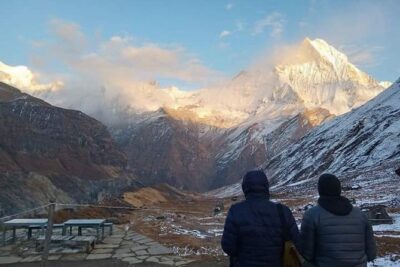
The best part of this 11-day Annapurna Base Camp trek is the changing scenery. You move from river valleys and Gurung villages to rhododendron forest, high mountain paths, and the great amphitheater around Annapurna Base Camp. The route also adds a Poon Hill sunrise, which gives you a second grand mountain viewpoint.
I like the small group of up to 10 people, since that is a sensible size for a mountain trek. I also like the practical package: transport, permits, meals, lodging, a guide, a sleeping bag, and a down jacket are covered. The main consideration is fitness. This is not a gentle sightseeing trip, and several days involve long climbs or descents on stone steps.
Key points to know before booking
- Poon Hill sunrise comes before base camp, giving you sweeping views of Dhaulagiri, Annapurna I, Annapurna South, Nilgiri, and other peaks.
- The trek begins and ends with long bus rides, including roughly seven hours between Kathmandu and Pokhara.
- The group is capped at 10 people, a useful balance between companionship and manageable trail logistics.
- Meals and 10 nights of lodging are included, but drinks, desserts, personal costs, porter service, and tips are extra.
- A guide, conservation permits, TIMS, sleeping bag, down jacket, and map are included, which removes much of the usual planning work.
- A guide such as Indra can be especially helpful for first-time high-altitude trekkers, with route and weather decisions handled on the trail.
Why this route works so well in 11 days
Annapurna Base Camp is a fine choice if you want a serious Himalayan trek without spending weeks on the trail. The route packs a lot into 11 days: road travel from Kathmandu to Pokhara, a gradual walk into the Annapurna region, an early climb to Poon Hill, the push to base camp, and a return through forest and villages.
The trip is designed as an organized package rather than an independent hiking plan. That matters in Nepal, where road transfers, permits, mountain lodging, meal stops, and weather can make a route harder to arrange than it looks on a map.
You get the social ease of a small group, but not a private trip. With a maximum of 10 people, you should expect to share the walking pace, lodging arrangements, and daily decisions with others. The booking pattern also suggests that people often reserve this well ahead, with an average booking lead time of 86 days. That is useful to know if your dates are fixed.
More Annapurna Base Camp Treks in Kathmandu
- Annapurna base camp trek 5 Days
★ 5.0 · 252 reviews - Annapurna Base Camp Trek
★ 5.0 · 111 reviews - Kathmandu to Annapurna Base Camp (ABC) 5-Day Trek
★ 5.0 · 102 reviews
Day 1: Kathmandu to Pokhara by the Trisuli River
The first day is mostly a road journey. A tourist bus leaves Kathmandu and heads toward Pokhara, with about seven hours on the road. The route follows the Trisuli and Marsyangdi rivers, both scenic waterways known for rafting, and offers views toward Ganesh Himal and Manaslu.
This is not merely dead time between two hiking days. The road gives you an introduction to rural Nepal, river valleys, satellite towns, and mountain country. Still, seven hours on a bus can feel long, especially after an international flight. The airport pickup is included, but you should be ready for a full first day rather than a relaxed arrival.
The day is described with a stop at Malekhu, and the itinerary places you in Pokhara before the walking section begins. Pokhara is a useful staging point, with time to settle in before heading toward Nayapul.
Day 2: Nayapul to Tikhedunga through Birethanti
After breakfast, you drive about an hour and a half to Nayapul. From there, the trek begins, passing through Birethanti at about 1,065 meters before continuing to Tikhedunga at roughly 1,577 meters.
This first walk is a good introduction to the route. You leave the road behind and enter a region of villages, footpaths, and river valleys. The elevation gain is present but not yet extreme, so you can focus on finding a comfortable pace and getting used to walking with your pack.
The four-hour walking day is shorter than several that follow. I would treat it as a chance to learn how the group moves, how much water you need, and how your boots feel on uneven ground. Do not spend all your energy trying to be first. You will need it later.
Day 3: The long stair climb toward the higher villages
The next day brings a steep ascent for about two hours, followed by a gentler climb through Ulleri at approximately 2,070 meters and Banthanti. The total walking time is listed at about six hours.
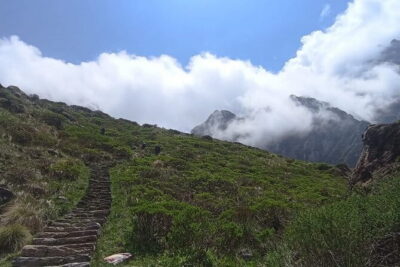
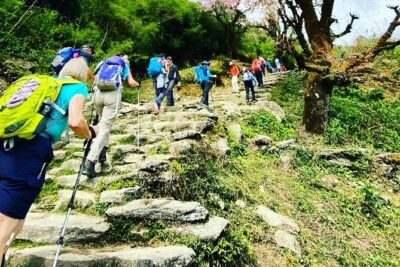
The stone stairways in this part of the Annapurna route are famous for testing the legs. The reward is a steady change in the surroundings as the path rises above the lower valleys. You pass through forest and mountain settlements, with views opening and closing as the trail bends.
This is one of the first days when moderate physical fitness becomes more than a note in the booking details. Break the climb into small sections. A guide can help set a steady pace, and a group leader such as Indra is useful when the weather changes or the trail feels harder than expected.
More Hiking Tours in Kathmandu
- Everest Base Camp Trek – 14 Days
★ 5.0 · 1,499 reviews - Everest Base Camp Trekking
★ 5.0 · 485 reviews - Nagarkot Sunrise View and Day Hiking from Kathmandu
★ 5.0 · 471 reviews - Annapurna Circuit Trek with Tilicho Lake
★ 5.0 · 368 reviews
Day 4: Poon Hill for sunrise
The early climb to Poon Hill, at about 3,232 meters, is one of the trip’s big highlights. You go before breakfast to catch sunrise over a wide collection of Himalayan peaks, including Dhaulagiri at 8,167 meters, Tukuche Peak, Nilgiri, Varaha Shikhar, Annapurna I at 8,091 meters, and Annapurna South.
This is the day that gives the trek its broad mountain panorama. Annapurna Base Camp later places you inside the mountains, while Poon Hill lets you look across them from a high ridge. The two views feel different, and having both is a major strength of this route.
The early start is the obvious drawback. You will be walking before daylight and then continuing for around six hours. Bring warm layers, even if the lower villages feel mild. The included down jacket can be returned after the trek, which is a useful bit of equipment support.
Day 5: Forest trails from Ghorepani
After the Poon Hill section, the trail descends through rhododendron, oak, and other dense forest. The walking time is about five hours, and the route passes through the Ghorepani area.
This day changes the mood of the trek. Instead of a high open viewpoint, you get shaded paths, bird sounds, and a closer look at the mountain forest. The route is not simply a march from one famous point to another. These quieter sections are part of what makes the journey feel connected to local villages and the natural setting.
The descent can be harder on knees than a climb is on lungs. Trekking poles, if you use them, would be helpful, though they are not listed among the included equipment. Your main supplied items are a sleeping bag, down jacket, and map, when needed.
Day 6: Across the Chhomrong Khola
This is a longer day of about seven hours. The path descends on stone steps for roughly an hour and a half, crosses the Chhomrong Khola on a suspension bridge, and then climbs again toward the side of the valley.
This up and down rhythm is typical of Himalayan trekking. A route that looks like a descent on paper may still include a demanding climb after the river. Chhomrong is an important point on the approach to the sanctuary, and the village marks a shift toward the more enclosed upper valley.
You should plan to eat steadily on this day. Breakfast, lunch, and dinner are included across the trek, but alcoholic drinks, nonalcoholic drinks, desserts, and personal purchases are not. Carry money for those extras and do not assume every comfort is part of the package price.
Day 7: Into the Annapurna Sanctuary
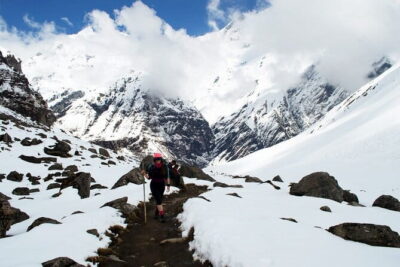
From Chhomrong, the valley widens and becomes less steep in places. You pass through the gates of the sanctuary, then continue across two avalanche areas as the trail enters the upper mountain basin. The walking time is about six hours.
This is where the route begins to feel more remote and enclosed. The mountains are no longer distant points on a horizon. They surround the trail, and the scale changes as you approach the base camp area.
The avalanche crossings are worth noting. The itinerary identifies them as part of the route, but it does not promise a particular trail condition. Mountain paths can vary with weather and seasonal conditions, so follow the guide’s instructions rather than treating the listed schedule as fixed to the minute.
Day 8: Annapurna Base Camp and the return to Dovan
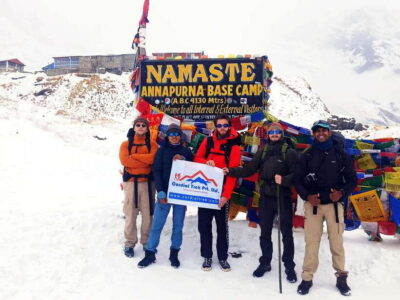
After breakfast, you reach Annapurna Base Camp and spend time taking in the surrounding Himalayan views. You then begin the return walk toward Dovan, with about six hours of trekking listed for the day.
Reaching ABC is the central goal, but the return begins quickly. This is not a plan with a long extra day at base camp. You should enjoy the viewpoint, take your photographs, and keep enough energy for the descent.
The walk back also changes how you see the route. On the way in, you are focused on altitude and the next overnight stop. On the way out, you can notice the valley shape, waterfalls, forests, and villages more easily. The natural hot spring included in the overall experience is another welcome feature, though the day and exact location are not specified in the schedule.
Days 9 and 10: Back through Bamboo and Nayapul
The return route descends through forests of rhododendron, oak, and bamboo, passing through Bamboo. One section is steep for about an hour before the path continues toward lower ground. The following day brings a descent and flatter walking toward Birethanti, where you stop for lunch before walking about 30 minutes to Nayapul.
These days are less about new mountain targets and more about finishing safely. The forests offer a different kind of pleasure from the high peaks, and the lower elevation can make breathing easier. At the same time, tired legs make downhill stone steps surprisingly demanding.
The schedule gives Day 9 around six hours and Day 10 a shorter walking period before the transfer. Use the final walking day to stay controlled. Many trekking problems happen when people rush the last descent because they are eager to reach the road.
Day 11: Pokhara to Kathmandu
The final day starts with a tourist bus at 7 a.m. after breakfast. The ride back to Kathmandu takes about seven hours and passes satellite towns, rural settlements, rivers, and more roadside scenery.
As on the first day, the bus transfer is part of the experience and part of the compromise. It keeps the package cost lower than arranging private vehicles, but it takes time. Do not schedule an important international flight immediately after this transfer. The supplied information does not promise a specific arrival time, and road conditions can affect the journey.
Airport pickup and drop-off are included in the tour arrangement, though the meeting point is Tribhuvan Airport in Kathmandu and the listed start time is 7:15 a.m. Confirm the exact pickup details after booking.
What the $785.72 price covers
At $785.72 per person, the package offers solid value for someone who wants the main logistics handled. The price includes a guide, Kathmandu to Pokhara and return transport by tourist bus, 10 nights of accommodation, meals listed as eight dinners, nine lunches, and 10 breakfasts, permits, taxes, and the TIMS registration.
Guide costs are also covered, including the guide’s salary, food, drinks, accommodation, transportation, and insurance. A sleeping bag, down jacket, and trekking map are supplied when necessary and returned after the trek. Those inclusions matter because renting or arranging each item separately takes time and can add cost.
The package does not include a porter. If you want one, the listed rate is $20 per day. International flights, the Nepal entry visa, travel insurance, tips for the guide and driver, personal expenses, and all alcoholic drinks, soft drinks, and desserts are extra.
Insurance is compulsory, not optional. You should also budget for drinks and small purchases along the route. The trip is all-inclusive in the practical sense, but not in the resort sense.
Who should book this trek
I would recommend this trip to you if you want a structured introduction to Himalayan trekking and prefer not to arrange every permit, bus, lodge, and meal yourself. The route suits a person with moderate physical fitness who can manage repeated climbs, descents, long walking days, and an early morning at altitude.
It is also a good fit if you want more than one famous viewpoint. Poon Hill gives you a wide sunrise panorama, while Annapurna Base Camp places you within the mountain basin. The Gurung villages, forest paths, suspension bridge, river valleys, and hot spring add variety.
I would hesitate if you want a relaxed holiday, private transport, or a short walk with plenty of spare time. The seven-hour bus journeys and several six to seven-hour trekking days make this an active schedule. A porter costs extra, so decide in advance whether you want to carry your own gear.
The small group is a real advantage, and one detailed experience specifically praised guide Indra for careful attention to routes, terrain, and weather. That is the sort of support you want on a first high-altitude trek. The overall rating is 4.9 from 81 reviews, with 99 percent recommending the experience, but you should still take the fitness demands seriously.
Final call: a strong value trek with real physical demands
Book this Annapurna Base Camp trek if you want a well-organized mountain challenge with major costs handled upfront. You get the best parts of the route, including Poon Hill, the sanctuary, base camp, village trails, forest, and mountain views, without having to build the entire trip yourself.
Skip it if your priority is comfort or flexibility. The bus rides are long, the trail includes steep stone steps, and several days run for six or seven hours. For the right person, though, the mix of practical support, small-group size, included permits, and two landmark Himalayan viewpoints makes the $785.72 price appealing.
The cancellation terms are simple: cancel at least three full days before the local start time for a full refund. Changes or cancellations inside that window are not accepted for a refund.
FAQ
How long is the Annapurna Base Camp trek?
The experience lasts approximately 11 days, including the bus journeys between Kathmandu and Pokhara.
Where does the tour start?
The listed meeting point is Tribhuvan Airport in Kathmandu, Nepal. The listed start time is 7:15 a.m., and airport pickup and drop-off are included.
What group size can I expect?
The group has a maximum of 10 travelers.
Are meals and accommodation included?
Yes. The package includes 10 nights of accommodation, eight dinners, nine lunches, and 10 breakfasts.
Is a porter included?
No. A porter is available at the listed rate of $20 per day, if you need one.
What is not included in the price?
International flights, the Nepal entry visa, travel insurance, tips for the guide and driver, personal expenses, alcoholic and nonalcoholic drinks, desserts, and any other expenses not specifically listed as included are excluded.
Recently added around Kathmandu
- Kathmandu Airport Pickup and Drop-off Services★ 5.0 · 3 reviews
- Kathmandu Paragliding★ 5.0 · 3 reviews
- Kathmandu Chandragiri Cable Car and Swayambhunath Private Tour★ 5.0 · 3 reviews
- Explore The Beauty Of Langtang Valley In 8-Days Trek★ 5.0 · 3 reviews
- Kathmandu: Nightlife and Pub Crawl Tour★ 5.0 · 3 reviews
- Kathmandu: Momo Making Class with a Local Chef★ 5.0 · 3 reviews
- Mountain Flight Experience in Nepal★ 4.5 · 3 reviews
- Thangka Painting Workshop★ 5.0 · 3 reviews
Other Annapurna Base Camp Treks worth a look
Kathmandu to Annapurna Base Camp (ABC) 5-Day Trek
Read our review →
11-Day Hike Tour to Annapurna Base Camp Bliss in Kathmandu
Read our review →This tour also appears in