
REVIEW · EVEREST BASE CAMP TREKS
Everest Base Camp Trek | Deluxe Lodges | Both Way Helicopter Ride
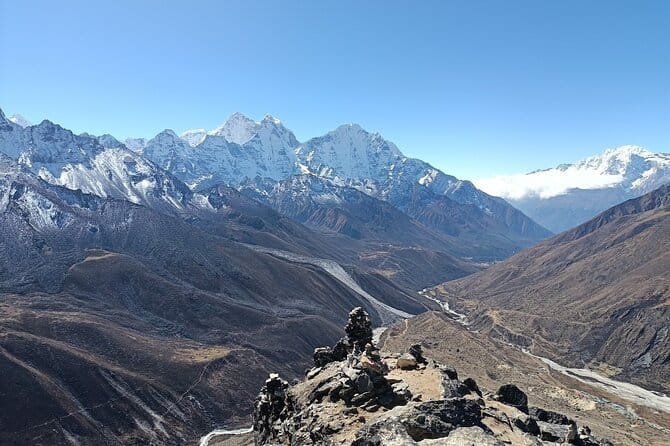
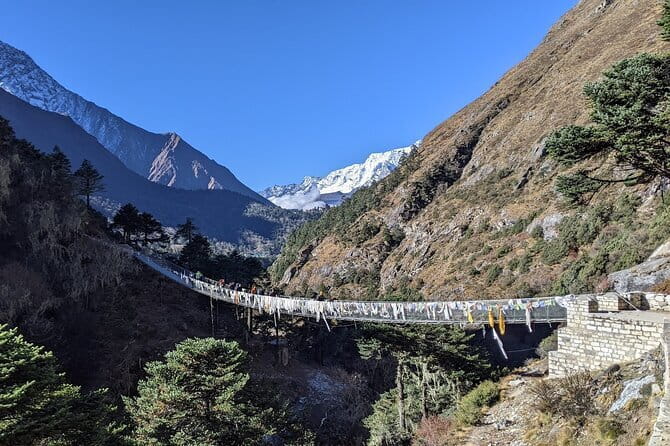
The best feature here is simple: you walk the classic Everest Base Camp route but save time and effort with helicopter flights. You still pass through Sherpa villages, cross suspension bridges, sleep in Namche and Dingboche, and reach Base Camp, but you avoid the long return trek.
I like the two planned acclimatization days, especially the hike toward the Hotel Everest View and the high-altitude outing above Dingboche. I also like the practical package: permits, meals, porters, warm sleeping bags, down jackets, airport transfers, and guide support are covered. The main consideration is the pace. Ten days is short for a trek reaching more than 5,000 meters, so you need strong fitness and must take altitude symptoms seriously.
Key points to know before booking
- Shared helicopter flights save return-trek days: The package includes helicopter travel from Kathmandu to Lukla and a return flight from the Everest region toward Lukla and Kathmandu.
- Two acclimatization days are built in: You hike above Namche and Dingboche rather than simply resting in the lodges.
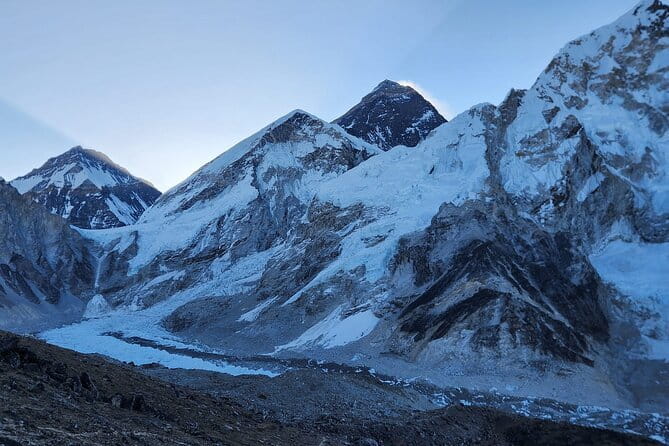
- The route reaches both Base Camp and Kala Patthar: Kala Patthar provides the sunrise viewpoint, while Base Camp gives you the sense of standing at the gateway to Everest.
- Deluxe lodge accommodation means twin-share rooms: Kathmandu lodging is in a three-star hotel, while mountain nights use the best available lodges.
- Guides and porters are part of the operating team: The company assigns one porter for every two people and supplies staff insurance, equipment, food, and wages.
- The price covers a lot, but not everything: At $3,332 per person, insurance, Nepal entry fees, international flights, drinks, snacks, and Kathmandu lunches and dinners remain outside the package.
Why the 10-day Everest Base Camp plan works
A standard Everest Base Camp trip often needs more time because you walk both ways from Lukla. This plan cuts the return by helicopter, leaving ten days for the approach, acclimatization, Base Camp, and Kala Patthar.
That time saving matters if you have a tight holiday schedule. You still get the essential rhythm of the Khumbu route: a flight into Lukla, lower-elevation walking, a stay in Namche Bazaar, a gradual rise through Tengboche and Dingboche, and the final push to Gorakshep and Base Camp.
The trade-off is clear. You are not getting a gentle mountain holiday. The itinerary includes several five-hour walking days and a demanding final section at high altitude. Day 8 is described as relatively light, but you still gain altitude toward Lobuche. Day 9 combines the trek from Lobuche to Gorakshep with the walk to Everest Base Camp.
I would choose this version for someone who wants the main Everest experience but cannot spare two or three weeks. I would not choose it simply because the helicopter makes the trek easy. It does not. The helicopter removes the long descent, not the high-altitude climb.
More Hiking Tours in Kathmandu
- Everest Base Camp Trek – 14 Days
★ 5.0 · 1,499 reviews - Everest Base Camp Trekking
★ 5.0 · 485 reviews - Nagarkot Sunrise View and Day Hiking from Kathmandu
★ 5.0 · 471 reviews
Kathmandu arrival, Thamel, and the first night
Your trip begins with a private airport pickup in Kathmandu. A company representative meets you at Tribhuvan International Airport and takes you by car or van to the hotel in Thamel.
Thamel is a useful base before and after the trek. You can rest after your flight, sort your gear, and meet the trekking team. The package includes two nights at a three-star hotel with breakfast, one before and one after the mountain section.
The first day is intentionally light. That is sensible. You are better off sleeping, checking your luggage, and preparing for the early departure than trying to squeeze in a packed sightseeing schedule.
The final Kathmandu night includes a farewell meal at a traditional Nepali cultural restaurant. Lunch and dinner in Kathmandu are not included on the ordinary days, so budget separately for those meals and for drinks and snacks throughout the trip.
Helicopter flight to Lukla and the walk to Phakding
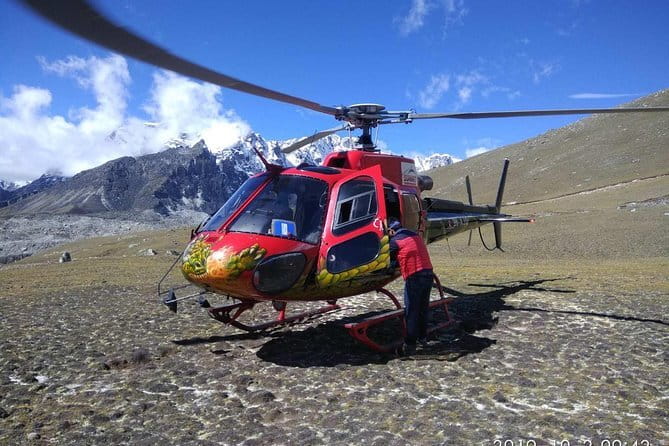
The morning flight to Lukla is one of the trip’s most memorable opening scenes. The shared helicopter flight takes about 45 minutes and offers views toward Everest and Kanchenjunga before landing at Tenzing-Hillary Airport.
Helicopter travel can be a practical choice for a short itinerary, but you should understand the word shared. You are not booking a private aircraft for your group alone. The flight arrangement is part of a scheduled mountain transfer, and the exact operating details can depend on conditions and local flight arrangements.
After landing, you begin walking toward Phakding. This first section is described as gentle and fairly short, giving you an early chance to settle into the pace. The trail follows the Dudh Koshi River, with pine forest and village scenery around you.
Phakding is less about a major sight than about beginning the physical routine. Eat well, drink regularly, and keep the first day controlled. The temptation is to walk fast because the route feels manageable. A slower start is the smarter choice.
Hillary Bridge and the first views of Everest near Namche
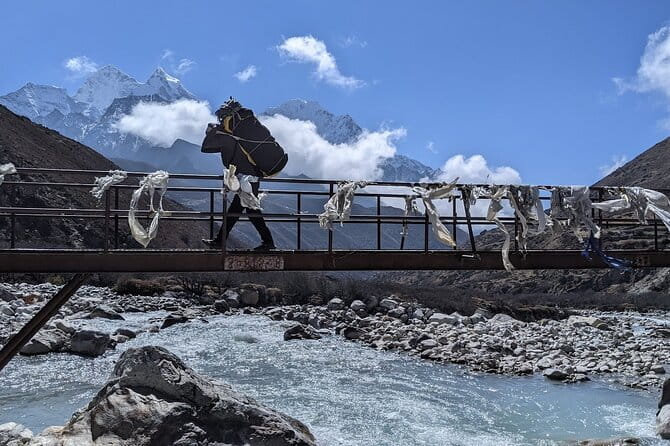
The next stage follows the Dudh Koshi through pine forest and villages including Benkar and Monjo. You cross suspension bridges, with the Hillary Bridge serving as a memorable point on the route.
Monjo is also associated with the entry area for Sagarmatha National Park. The package covers the national park permit and the Pasang Lhamu Rural Municipality permit, so you do not need to arrange those separately.
The trail then climbs toward Namche Bazaar, where the Dudh Koshi and Bhote Koshi meet. This is a real step up in effort. After the final steep ascent, the first glimpse of Everest appears beyond the Lhotse and Nuptse range.
Namche sits at 3,440 meters and is the main trading and service center on the route. You will find restaurants, shops, massage centers, and spa services, along with lodges and the busy market atmosphere that makes Namche feel different from the smaller villages below.
Do not treat Namche as just a sleeping stop. It is where the altitude begins to demand respect. Your guide can help set the pace, and your free time is best used for eating, resting, and short walks rather than exhausting shopping missions.
More Everest Base Camp Treks in Kathmandu:
- Everest Base Camp Helicopter Tour landing at Everest View Hotel
★ 5.0 · 668 reviews - Everest Base Camp Trekking – 13 Day
★ 5.0 · 365 reviews - Everest Base Camp Trek -14 Days
★ 5.0 · 321 reviews - Everest Base Camp Helicopter Tour landing at Hotel Everest View
★ 5.0 · 218 reviews
Namche acclimatization and Hotel Everest View
The first acclimatization day takes you uphill toward Syangboche and the Hotel Everest View, at about 3,880 meters. The idea is to climb higher during the day and sleep lower in Namche that night.
This is a good design choice. A rest day does not have to mean sitting indoors all day, and a gentle high walk gives you a useful test of how your body handles the altitude. The Hotel Everest View is known for its broad views of Everest, Ama Dablam, Lhotse, and nearby peaks.
The stop at the hotel is listed as a 30-minute visit, and admission is not included. Plan for that small extra cost if you want to sit with a coffee and take in the view.
You also have about five hours to explore Namche. That is enough time to browse the market, eat at a restaurant, book a massage, or simply rest. I like this part of the schedule because it gives you both a mountain viewpoint and time to recover.
Tengboche Gompa and the Sherpa heart of the route
After Namche, the trail continues through the Dudh Koshi valley before crossing a suspension bridge into the Imja Khola area. The route leads to Tengboche Gompa, one of the best-known cultural stops on the Everest Base Camp trail.
The monastery adds meaning to the walk. This is not only a route to a famous mountain. You are moving through Sherpa communities where Buddhist practice, mountain work, and village life are part of the setting.
The day is listed at about five hours of walking. That sounds manageable, but the route continues to rise and can feel harder than the clock suggests. Keep your layers handy and avoid using all your energy early in the day.
Tengboche is also one of the places where Ama Dablam becomes especially memorable. The mountain views are a major reward, but the monastery is the reason to pause. Give yourself time to appreciate the setting rather than treating the stop as a quick photo break.
Pangboche, Dingboche, and the second acclimatization day
From Tengboche, you continue toward Pangboche, passing Buddhist sites and enjoying views of Ama Dablam and other high peaks. The Pangboche Buddhist monastery is included as a stop, and the walking time is again listed at about five hours.
The itinerary then reaches Dingboche, where you spend the second acclimatization day. This follows the useful high-low approach: climb higher during the day, then return to Dingboche to sleep.
The exact outing is described as a climb to a higher point above the village. This is the sort of day that tests your breathing without requiring you to carry your full load or cover a huge distance. Your guide’s judgment matters here. The goal is not to win a race. The goal is to help your body adjust.
Dingboche is also where the route begins to feel properly high and exposed. The trees become less dominant, the air feels thinner, and walking uphill takes more concentration. I would use the afternoon to organize your pack, charge devices if possible, eat a full meal, and sleep early.
Lobuche and the memorials at Thukla Pass
The route from Dingboche toward Lobuche is described as a relatively light trekking day, but it still gains significant altitude. You follow steep slopes toward the broad valley of Dughla, then continue past memorials near Thukla.
These memorials honor climbers and Sherpa guides who died on Himalayan expeditions. The stop changes the mood of the trek. Everest is often presented as a grand adventure, but this section reminds you that high-altitude climbing carries real risk and demands respect.
Lobuche is a key staging point for the final Base Camp push. The itinerary lists about 14 hours at this stop, which should not be read as 14 hours of walking. It refers to the time allocated around the stop, while the actual walking day is described as light.
At this elevation, basic habits become important. Keep your water close, protect yourself from cold, and tell your guide promptly about headaches, nausea, unusual tiredness, or breathing trouble. The package includes first-aid kits and an oximeter for the staff and group, but equipment does not replace honest communication.
Gorakshep and the walk to Everest Base Camp
The most demanding and anticipated day takes you from Lobuche to Gorakshep and then onward to Everest Base Camp. The route crosses rough glacier terrain and takes about four hours to reach Gorakshep before the Base Camp outing.
Gorakshep is the last overnight settlement on this part of the route. From there, the trail continues over rocky ground toward Base Camp. The destination is not a conventional viewpoint with a single dramatic building. It is a mountain expedition staging area, marked by the glacier, climbing equipment during the climbing season, and the knowledge that Everest’s summit route begins beyond it.
The package includes the Base Camp permit or admission noted for this stop, along with the necessary trekking permits overall. You also carry a trail map supplied by the company, though your guide remains the main source of route direction and safety support.
This is a long day at altitude. You may feel that the distance is short on paper, yet each uneven step takes more work. Keep your expectations realistic. The reward is not comfort. It is reaching a place that has become a symbol of high-altitude exploration while seeing the Khumbu ice and surrounding peaks at close range.
Kala Patthar sunrise and the helicopter return
Early on the final morning, you hike up Kala Patthar before sunrise. This viewpoint is valued for its panorama of Everest and the surrounding mountains, and the morning light on the summit is the final major sight of the trip.
The climb is short in terms of time, listed at about five hours, but it can feel tough because of the altitude and the early start. Bring warm clothing. The supplied down jacket and sleeping bag are rated for cold conditions, and you return both after the trip.
The package includes a shared helicopter from the Everest Base Camp area at Gorakshep toward Lukla, plus helicopter travel between Lukla and Kathmandu. The detailed day-by-day schedule focuses on Kala Patthar and does not spell out every flight connection, so confirm the exact return sequence and expected timing before departure.
This flight is the practical payoff of the itinerary. Instead of retracing the trail through Lobuche, Dingboche, Namche, and Phakding, you return by air. It also gives you a different view of the valleys you crossed on foot.
What the $3,332 price covers
At $3,332 per person, this is not a budget trek. The price makes more sense when you look at the costly and useful items included.
You receive shared helicopter flights, private airport transfers, two Kathmandu hotel nights with breakfast, twin-share mountain lodges, a licensed guide, and one porter for every two people. Meals include 10 breakfasts, 8 lunches, and 8 dinners, which covers the mountain portion and the listed overnight schedule.
The operator also covers guide and porter wages, food, transportation, equipment, and accidental insurance for its staff. Permits, taxes, office charges, a duffel bag, a T-shirt, a map, first-aid supplies, a down jacket, and a cold-weather sleeping bag are included.
You still need to pay for international airfare, a Nepal entry visa, travel insurance with rescue and evacuation protection up to 5,500 meters, beverages, snacks, and meals in Kathmandu apart from breakfast. Insurance deserves special attention. Do not assume ordinary holiday coverage will pay for a high-altitude rescue.
The published feedback gives the company six five-star ratings, with repeated praise for organization, flexibility, and guide support. Specific guides named in the feedback include Tika, Pramod, Prakash, and Rabin. One account describes an 11-day version with a helicopter return from Gorak Shep, so confirm your exact number of days and flight plan if those details matter to you.
Fitness, luggage, and practical planning
You need strong physical fitness for this trip. The route includes steep climbs, high altitude, long walking days, cold conditions, and uneven ground. The helicopter return does not remove the hardest uphill sections.
The stated luggage allowance is 10 kilograms for a large bag and 5 kilograms for a handbag. A porter carries the main duffel, with one porter assigned to two people. Pack carefully and keep essentials such as medication, documents, water, warm layers, and personal items with you.
The tour is private, meaning only your own group participates. That can make it easier to adjust the walking rhythm and discuss concerns with the guide. The company also states that it coordinates emergency and rescue operations, but you are still responsible for obtaining suitable insurance.
Confirmation is provided at booking, pickup is available, and the activity begins and ends at the Life Himalaya Trekking office at Narsingh Chowk Marg in Kathmandu. Free cancellation is available up to 24 hours before the start time under the stated policy.
Should you book this Everest Base Camp trek?
I would book this trip if you want the essential Everest Base Camp route, have about ten days, and value helicopter travel over a longer walk back to Lukla. The package is especially suited to fit hikers who want structured support, included meals and permits, and a private group with a guide and porter team.
I would pause if you want a slow acclimatization schedule or a long cultural stay in the mountain villages. Ten days is efficient, not leisurely. You should also compare the price with longer lodge treks if you do not need the helicopter return.
For the right person, this is a well-equipped shortcut, not an easy shortcut. You get Sherpa villages, Namche, Tengboche, two acclimatization days, Base Camp, Kala Patthar, and a helicopter exit. Confirm the flight details, buy proper rescue insurance, and book only when you are ready for the altitude.
FAQ
How long is the Everest Base Camp trek?
The experience is planned for approximately 10 days, including Kathmandu stays, the trek, acclimatization days, Base Camp, Kala Patthar, and helicopter transportation.
Are helicopter flights included?
Yes. Shared helicopter flights from Kathmandu to Lukla and from Lukla to Kathmandu are included. A shared helicopter flight from the Everest Base Camp area at Gorakshep to Lukla is also included.
Is accommodation included?
Yes. The package includes two nights at a three-star hotel in Kathmandu with breakfast and twin-share accommodation in the best available lodges during the trek.
What meals are included?
The package includes 10 breakfasts, 8 lunches, and 8 dinners. Lunch and dinner in Kathmandu, along with beverages and snacks, are not included.
Do I need travel insurance?
Yes. Travel insurance covering rescue and evacuation up to 5,500 meters is not included and must be arranged separately.
How much luggage can I bring?
The stated allowance is 10 kilograms for a large bag and 5 kilograms for a handbag. One porter is provided for every two people.
Is this a private tour?
Yes. Only your own group participates. An experienced, government-licensed trekking guide is included, along with porters and emergency coordination support.
More Helicopter Tours in Kathmandu
- Everest Base Camp Trek with Helicopter Return from Gorakshep to Lukla
★ 5.0 · 161 reviews - Everest Base Camp helicopter tour with landing
★ 5.0 · 61 reviews - Everest Base Camp Helicopter Tour with Hotel Everest View Landing
★ 5.0 · 52 reviews - Guaranteed Landing at Everest Base Camp Kalapathar by Helicopter
★ 5.0 · 38 reviews
Recently added around Kathmandu
- Kathmandu Paragliding★ 5.0 · 3 reviews
- Kathmandu Airport Pickup and Drop-off Services★ 5.0 · 3 reviews
- Kathmandu Chandragiri Cable Car and Swayambhunath Private Tour★ 5.0 · 3 reviews
- Explore The Beauty Of Langtang Valley In 8-Days Trek★ 5.0 · 3 reviews
- Kathmandu: Nightlife and Pub Crawl Tour★ 5.0 · 3 reviews
- Mountain Flight Experience in Nepal★ 4.5 · 3 reviews
- Kathmandu: Momo Making Class with a Local Chef★ 5.0 · 3 reviews
- Everest Base Camp Trek★ 5.0 · 3 reviews
Other Everest Base Camp Treks worth a look


Everest Base Camp Helicopter Tour landing at Everest View Hotel
Read our review →


Everest Base Camp Helicopter Tour landing at Hotel Everest View
Read our review →

This tour also appears in