
REVIEW · KATHMANDU TOURS
Full Day Private Kathmandu City Tour
Kathmandu’s big four sights tell four very different stories: Hindu cremation rites at Pashupatinath, Tibetan Buddhism at Boudhanath, hilltop worship at Swayambhunath, and Newar art at Patan Durbar Square. This private tour links them in one long day, with a guide to explain what you are seeing instead of leaving you to decode it alone.
I like the private vehicle and door-to-door pickup, especially in a city where getting between major sights can take patience. I also like the chance to ask direct questions about religion, architecture, and daily life. Guide Saraswati Ghimire receives special praise for her warmth, humor, and strong knowledge. The main drawback is the pace: four major sites in 7 to 8 hours is efficient, but not leisurely.
Key points
- Four major Kathmandu attractions in one day: Visit Pashupatinath, Boudhanath, Swayambhunath, and Patan Durbar Square.
- A private art historian guide: Ask questions and adjust the conversation to your interests, with Saraswati Ghimire among the named guides.
- A serious look at Hindu and Buddhist practice: Expect sacred shrines, holy men, prayer traditions, and a possible cremation at Pashupatinath.
- Air-conditioned transport with hotel pickup: You avoid arranging separate rides across Kathmandu Valley.
- A useful price for a private day: At $95 per person, the value improves as your group size grows, though entry tickets and meals cost extra.
- A full but demanding schedule: The 9:15 am start leaves about a day for sightseeing, but each stop deserves more time than the schedule may allow.
Four Sacred Sites, One Long Kathmandu Day
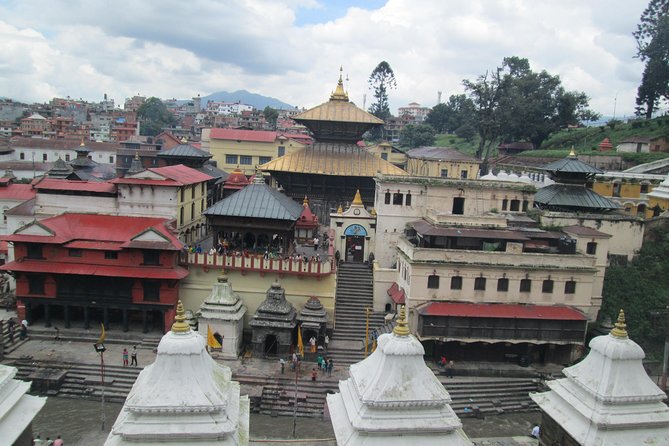
This tour gives you a broad introduction to Kathmandu Valley in a single outing. You move from Hindu worship beside the Bagmati River to Buddhist devotion around a great stupa, then up to a hilltop shrine and on to the carved courtyards of Patan.
That range is the real strength of the day. You are not seeing four versions of the same temple. You are comparing Hindu and Buddhist beliefs, royal architecture, pilgrimage customs, and the artistic traditions that shaped Kathmandu.
The tour starts at 9:15 am and lasts about 7 to 8 hours. Pickup and drop-off are offered at your hotel, and the vehicle is private, air-conditioned, and supplied with bottled water. That removes a fair bit of friction from a city tour. You do not need to negotiate separate taxis or keep checking the route.
Still, four major stops make this a full schedule. You should think of the experience as a well-organized introduction rather than a slow study of every courtyard and shrine. If your main goal is photography, sketching, or extended temple time, you may want separate visits on another day.
More City Tours in Kathmandu
- Kathmandu: Private City Guided Tour
★ 4.9 · 174 reviews - Kathmandu Valley City Day Tour
★ 5.0 · 40 reviews - 4 UNESCO City Sightseeing in Kathmandu
★ 5.0 · 36 reviews
Pashupatinath and the Bagmati River
Pashupatinath is one of the most important Hindu sites in Kathmandu. The temple complex sits beside the Bagmati River, and the riverbank includes the famous burning ghats used for Hindu cremation rites.
This is the tour’s most direct encounter with the Hindu idea of impermanence. A cremation may be taking place, but it is not guaranteed. The experience can feel solemn and confronting, so approach the river respectfully and follow your guide’s advice about where to stand and what is appropriate to photograph.
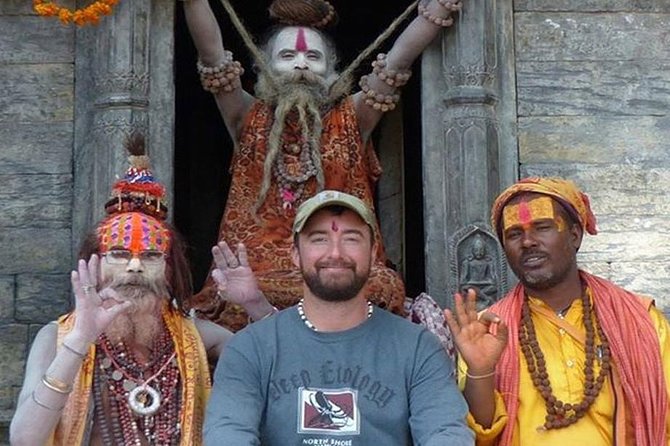
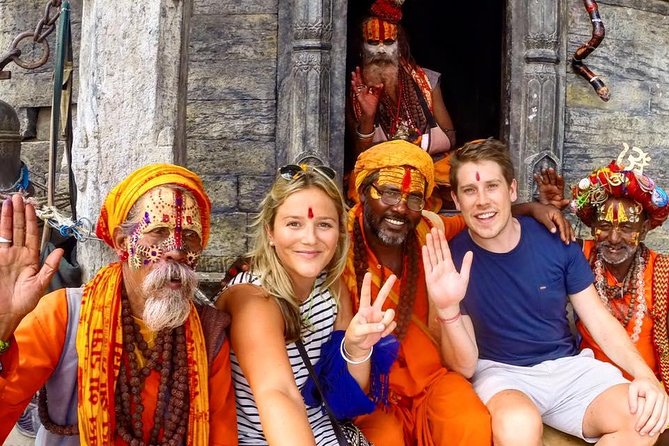
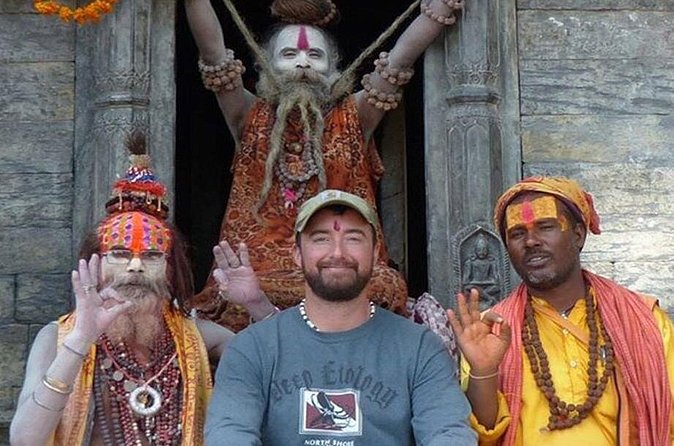
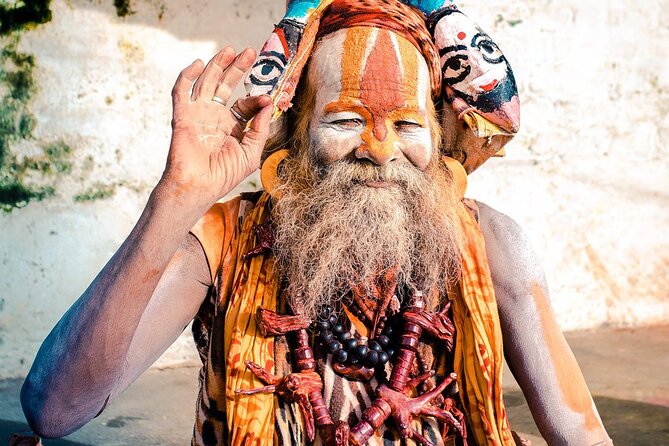
The tour description also points to Hindu holy men at Pashupatinath. You may see them around the temple grounds, adding a human presence to a place that can otherwise seem like a collection of carvings, steps, and ritual spaces. Your guide can help explain the difference between what is meant for public viewing and what belongs to private religious practice.
Pashupatinath is not simply a pretty temple stop. It is a working place of worship and mourning. That makes it one of the most meaningful parts of the day, but also one where you should avoid treating the setting like a theatrical display.
The drawback is that some parts of the complex may feel emotionally heavy. If you are uncomfortable around cremation grounds, you can still gain plenty from the temple architecture and religious context, but you may prefer a shorter stay beside the ghats.
Boudhanath Stupa and the Pilgrimage Circuit
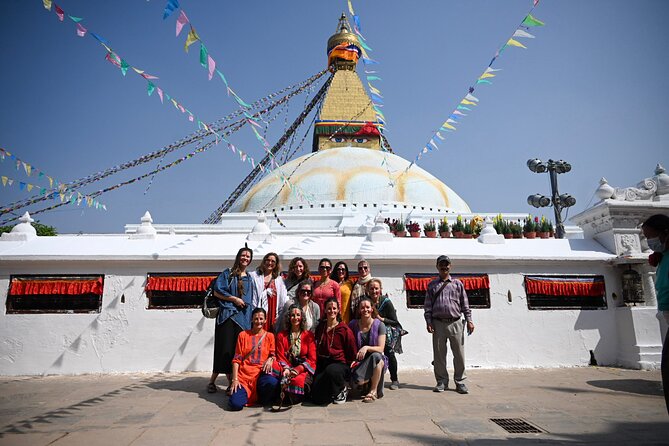
Boudhanath, also called Bouddhanath, is about 7 kilometers east of Kathmandu’s center and is listed as a UNESCO World Heritage cultural site. Its huge white dome and watchful eyes make it one of the city’s most recognizable monuments.
The stupa is important not only for its scale but for how people use it. Buddhist pilgrims circle the structure as part of their worship. The circular layout helps you understand why this is a place of movement and repetition rather than a building you simply enter, inspect, and leave.
I like this stop because the form is easy to appreciate even if you know little about Buddhism. The dome, square tower, painted eyes, and prayer traditions give your guide many clear points to explain. With a private guide, you can ask about the symbolism instead of relying on a quick caption or a hurried group explanation.
Boudhanath also provides a useful contrast with Pashupatinath. Both are major religious destinations, but their visual language and ritual customs differ. Seeing them on the same day lets you compare Nepal’s Hindu and Buddhist traditions while the details are still fresh in your mind.
Your time here may feel short if you want to walk several circuits or linger around the stupa. The tour includes all four major sights, so your guide has to keep an eye on the clock. If Boudhanath is your main reason for booking, tell the guide early. A private tour gives you more flexibility than a fixed group outing, though the overall day still has limits.
Swayambhunath on the Kathmandu Valley Hilltop
Swayambhunath is one of the oldest and most sacred religious sites in Kathmandu Valley. It sits on a hilltop and is an important pilgrimage place for Buddhists from many parts of the world.
The elevated setting gives this stop a different feel from Boudhanath. Instead of approaching a large stupa in a city neighborhood, you reach a religious site placed above the valley. The tour information identifies Swayambhunath as a hilltop sanctuary, so you should expect the visit to include an uphill setting and a stronger sense of arrival.
Your guide’s role matters here. The site’s age and religious importance can be difficult to grasp from architecture alone. A good explanation can connect the hill, the shrine, and the wider Buddhist tradition without turning the visit into a lecture.
Swayambhunath is also a good place to slow down for a moment, if the schedule allows. You can take in the temple setting, look across Kathmandu Valley, and compare the quieter hilltop atmosphere with the more concentrated activity around Boudhanath.
The tour does not promise a set amount of free time, so do not assume you can explore every corner at your own pace. You will get a useful introduction, but serious photographers and visitors who want a long, unhurried visit may wish to return independently.
A few more Kathmandu days to weigh up
- Kathmandu: Full Day 7 UNESCO Tour with Lunch – Private/Group
★ 5.0 · 415 reviews - Kathmandu: Full Day Top 4 UNESCO Tour with Lunch – Private/Group
★ 5.0 · 269 reviews - Kathmandu: Full-Day 7 UNESCO Tour with Lunch – Private/Group
★ 4.9 · 247 reviews - Kathmandu: Full Day 7 UNESCO Tour with Lunch – Private/Group
★ 5.0 · 101 reviews
Patan Durbar Square and Newar Craft
Patan Durbar Square takes you into the artistic side of Kathmandu Valley. Patan is described as one of the oldest of the three cities within the valley and is known for traditional crafts and fine architecture.
This is where the art historian guide can be especially helpful. Temples, courtyards, and carved details can blur together when you see them quickly. A guide can direct your eye to the workmanship and explain why Patan is associated so strongly with artistic traditions.
The square is not just a royal setting. It represents the Newar cultural and architectural heritage that gives the Kathmandu Valley much of its distinctive character. Look closely at the wood and stone work, rather than rushing from one large building to the next.
Patan also rounds out the religious focus of the earlier stops. Pashupatinath and Boudhanath place worship at the center, while Patan gives you a stronger look at urban design, courtly architecture, and craftsmanship. Together, the four stops create a more complete picture of Kathmandu than any single temple could provide.
The tradeoff is time. Patan deserves a patient walk, and a full day that also includes three major religious sites cannot offer unlimited time in the square. If you are particularly interested in traditional crafts, tell your guide. The private format lets you shape the conversation around that interest.
What the Private Guide Adds
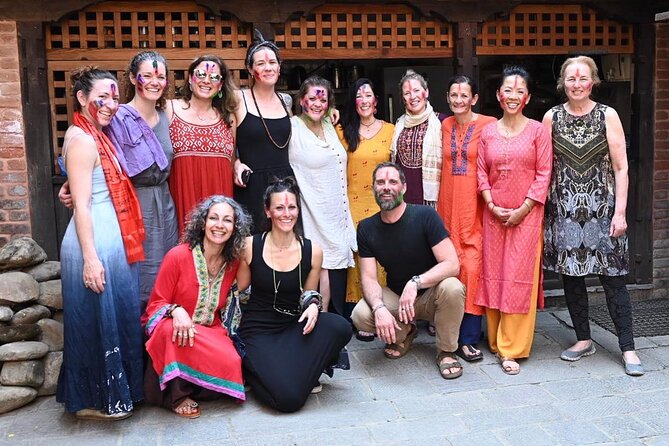
The guide is the main reason to choose this experience over arranging four separate taxi rides. The sites are visually impressive, but their meaning is not always obvious. A private art historian guide can explain the religious symbols, historical setting, and artistic details while you are standing in front of them.
You also have room to ask the questions that rarely fit into a large group tour. You might want to know how Hindu and Buddhist traditions overlap, why a stupa is designed as it is, or how Patan became known for its crafts. You can ask directly and keep the discussion at the level you find useful.
Saraswati Ghimire is specifically associated with the experience and is praised for her knowledge, friendliness, and sense of humor. That combination matters on a 7 to 8 hour tour. A guide who can explain serious subjects clearly while keeping the day relaxed is a better match than someone who simply recites dates.
The private setup also helps solo visitors and small groups. You are not waiting for strangers at each stop, and the guide can respond to your pace within the limits of the day. The experience is recommended by 100 percent of its 15 ratings, with a five out of five score. That is a small sample, but it does point to a consistently positive response, especially toward the guiding.
Is $95 Per Person Good Value?
The price is $95 per person. It includes the activities, private tour, professional art historian guide, hotel pickup and drop-off, bottled water, and an air-conditioned vehicle.
Entry permits and tickets are not included, and food and drinks are also extra. Keep those costs in mind when setting your day’s budget. The tour price is not the final total, but the included transport and guide cover the parts that are hardest to arrange smoothly on your own.
For one person, $95 is a meaningful expense. For a couple, family, or small group sharing the private vehicle and guide, the value becomes easier to justify. You are paying for a full day of transport, interpretation, and convenience rather than four isolated admissions.
I would compare it with the cost and effort of hiring transport between Kathmandu, Boudhanath, Swayambhunath, and Patan, then finding a guide at each site or reading enough beforehand to understand what you are seeing. If you already have a car and strong local knowledge, the tour may feel less necessary. If this is your first Kathmandu visit, the price is reasonable for the amount of ground covered.
Who Should Book This Kathmandu Tour?
This experience suits you if you want to see Kathmandu’s major sights in one day without managing the route yourself. It is especially useful for first-time visitors, couples, families, and solo visitors who want a private guide rather than a large group.
It also suits anyone interested in religion and art. The route gives you Hindu cremation traditions, Hindu holy men, Buddhist pilgrimage, a hilltop sanctuary, and Patan’s traditional crafts. That is a lot of cultural context for one day.
The tour may be less suitable if you dislike structured sightseeing or prefer to spend half a day at one temple. The schedule is ambitious, and admission costs are extra. You should also be prepared for the possibility of seeing a cremation at Pashupatinath, which can be a powerful but difficult part of the visit.
For the best experience, wear comfortable clothing and shoes suitable for walking around temple compounds and an elevated site. The supplied information does not specify a dress code or exact walking distance, so ask the provider if you have particular mobility concerns or clothing questions.
Practical Details Before You Go
Pickup is offered from the Kathmandu area, with the meeting location given as Kathmandu 44600, Nepal. The stated start time is 9:15 am, and hotel drop-off is included at the end.
Confirmation is provided when you book. Most people can participate, and the activity is private, meaning only your own group takes part.
Free cancellation is available if you cancel at least 24 hours before the local start time. Cancellations or changes made inside that 24 hour window are not refunded or accepted.
Dream Heaven Adventure Pvt. Ltd. operates the experience. Since the day includes four important sites and admission tickets are separate, confirm the pickup details and expected entry costs before departure.
Should You Book It?
Book this tour if you want a clear, efficient introduction to Kathmandu’s religious and artistic center, with a private guide and transport doing the hard work. The combination of Pashupatinath, Boudhanath, Swayambhunath, and Patan gives you an unusually broad look at the city in one day.
I would book it for a first visit, especially if you value explanation as much as sightseeing. I would skip it only if you already know the valley well, have your own transport, or want to spend a full day at one or two sites. The schedule is brisk, but at $95 per person, it offers solid value for a private day when the guide and transport are important to you.
FAQ
How long does the Kathmandu city tour last?
The tour lasts approximately 7 to 8 hours.
What time does the tour start?
The stated start time is 9:15 am.
Does the tour include hotel pickup and drop-off?
Yes. Hotel pickup and drop-off are included, along with private transport in an air-conditioned vehicle.
Which attractions are visited?
The tour visits Pashupatinath Temple, Boudhanath Stupa, Swayambhunath, and Patan Durbar Square.
Are entrance tickets and meals included?
No. Entry permits or tickets, food, and drinks are not included. Bottled water is included.
Is this a private tour?
Yes. Only your group participates, and a professional art historian guide leads the experience.
Recently added around Kathmandu
- Kathmandu Airport Pickup and Drop-off Services★ 5.0 · 3 reviews
- Kathmandu Paragliding★ 5.0 · 3 reviews
- Explore The Beauty Of Langtang Valley In 8-Days Trek★ 5.0 · 3 reviews
- Kathmandu Chandragiri Cable Car and Swayambhunath Private Tour★ 5.0 · 3 reviews
- Kathmandu: Nightlife and Pub Crawl Tour★ 5.0 · 3 reviews
- Kathmandu: Momo Making Class with a Local Chef★ 5.0 · 3 reviews
- Mountain Flight Experience in Nepal★ 4.5 · 3 reviews
- Everest Base Camp Trek★ 5.0 · 3 reviews
Other Kathmandu Tours worth a look


Private Kathmandu Sightseeing Tour | UNESCO World Heritage sites
Read our review →
Everest Base Camp Helicopter Tour landing at Everest View Hotel
Read our review →


Nagarkot Sunrise View and Day Hiking from Kathmandu
Read our review →
Full Day 7 UNESCO Tour with Lunch – Private/Group
Read our review →
This tour also appears in