
REVIEW · PASHUPATINATH TOURS
PashupatiNath and BoudhaNath – Private/Small Group
Pashupatinath and Boudhanath show two of Kathmandu’s major faiths within one compact outing. At Pashupatinath, you’ll learn about Hindu worship, cremation customs, and the 16 rites of passage. At Boudhanath, the mood shifts to Tibetan Buddhism, with prayer flags, monastery rituals, mandalas, and the Four Noble Truths.
I like the small maximum group of five, which gives you room to ask questions without losing the guide in a crowd. I also like the route’s human side: guide Santosh has been praised for explaining religion, food, culture, and local life, and for adjusting the timing when a guest wanted to see the evening aarati ceremony. The main drawback is that entrance fees cost about $13 extra, nearly as much as the $15 tour itself, and the cremation grounds may feel confronting.
Key points to know before booking
- Two major faiths in three hours: Move from Hindu Pashupatinath to Buddhist Boudhanath without spending a full day on organized sightseeing.
- A very small group: The tour accepts no more than five people, useful if you want to ask about symbols, ceremonies, and local customs.
- Strong guide element: Santosh is especially praised for his cultural, historical, and archaeological background. Some bookings have also been led by Shreya.
- A sensitive look at Hindu death rites: Aryaghat is an active cremation site, not a staged attraction, so respectful behavior matters.
- Extra costs are significant: Pashupatinath costs about NRP 1,000 and Boudhanath about NRP 400, paid in cash at the entrances.
- Ends at Boudhanath: You finish near the stupa gate and can continue exploring on your own or return to your accommodation.
Why this Kathmandu tour works
I like this experience because it does not treat Pashupatinath and Boudhanath as two unrelated photo stops. The guide connects them through Nepal’s religious life, explaining where Hinduism and Buddhism differ, where they overlap, and how the two traditions live side by side in Kathmandu.
The route also includes smaller places that many short city tours would skip. Mrigasthali Deer Park, Gorakhnath Mandir, Guhyeshwari Shaktipeeth, a Buddhist monastery, and a Thangka center give the three hours more texture. You are not only circling famous monuments. You are hearing stories about Shiva, Sati, Guru Gorakhnath, Padmasambhava, and Buddhist teaching.
The $15 base price is low for a private or small-group experience, but you should calculate the full cost before booking. Adding the two entrance fees brings the expected total to about $28 per person. That is still fair if you want interpretation rather than a quick look, especially because the group is capped at five and the tour ends at a major sight where you can keep exploring.
The experience is best for you if religion, ritual, and local culture interest you. It is less suitable if you want a relaxed stroll with little discussion, or if you would rather avoid active cremation grounds. The route has several stops and a transfer toward Boudhanath, so you should expect a steady three-hour visit rather than a slow café-style morning.
More Pashupatinath visits:
- Kathmandu Spiritual Sites: Bodhnath & Pashupatinath Tour
★ 5.0 · 185 reviews - Kathmandu: Pashupatinath Temple Evening Aarati Tour
★ 5.0 · 36 reviews - Kathmandu: Pashupatinath Temple Aarti Night Tour
★ 4.8 · 29 reviews
Starting at Pashupatinath Temple
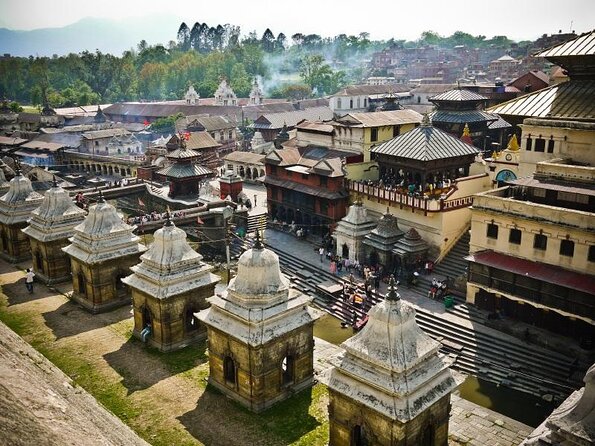
The meeting point is Gaushala Bus Stop on Ring Road, at P84V+VR2 in Kathmandu. The tour begins near Pashupatinath, the oldest Hindu temple in Kathmandu Valley and one of the most important Hindu pilgrimage sites in the region.
Non-Hindus cannot enter the main temple. That restriction is important to understand before you arrive, because the tour is not designed around an interior visit. Instead, you pass by the temple area and continue toward the Bagmati River and Aryaghat, while your guide explains the site’s religious role and the practices connected to it.
This is where a guide adds real value. A quick walk past the temple tells you very little about why the place matters. Santosh, who has led many of these visits, is praised for answering detailed questions and explaining both religious ideas and everyday culture. The experience can also be flexible. If ceremony timing matters to you, ask whether the schedule can be adjusted for aarati, as it has been for previous bookings.
Aryaghat and the Hindu rites of passage
Aryaghat is the cremation area beside Pashupatinath. The tour spends about 30 minutes here discussing Hindu last rites and the Shodasha Samskaras, the 16 rites of passage traditionally connected with a person’s life.
This is the most emotionally demanding part of the route. Cremations can take place here, and you may see funeral activity. The site is not presented as entertainment, so put your camera away unless your guide clearly says photography is acceptable. Quiet attention and modest dress are the sensible approach.
The guide’s explanation helps place what you see within Hindu belief. The focus is not only death, but the larger cycle of life, family duty, ritual, and spiritual transition. That context makes the visit more meaningful, but it does not remove its difficult edge. If you know that active cremation sites will be upsetting, you may want to discuss this before booking.
Shiva’s story at Mrigasthali Deer Park
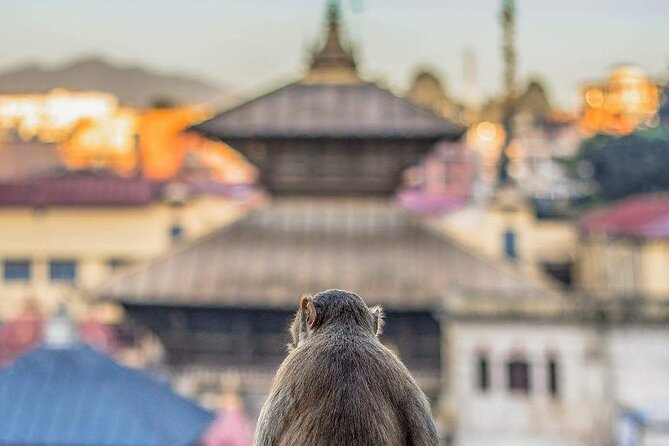
The next stop is Mrigasthali Deer Park, with about 15 minutes to explore the area. Here, the guide tells the story of Lord Shiva’s connection to the place and explains how the area received its name.
This is a welcome change of pace after Aryaghat. You get a short walk and a chance to absorb the setting instead of moving from one explanation straight into another. The stop is brief, so think of it as a story and orientation point rather than a long nature visit.
The tour’s strength is the way these smaller sites support the larger ones. Mrigasthali gives you a local legend and a physical sense of the area around Pashupatinath before the route continues toward Boudhanath.
More Boudhanath stupa visits:
- Sacred Pashupatinath: Aarati,Cremation Rites & Boudha Stupa
★ 5.0 · 18 reviews - Private Half-Day Tour of Boudhanath and Pashupatinath Temples in Kathmandu
★ 4.5 · 9 reviews - Bhaktapur Durbar Square and Boudhanath Stupa
★ 5.0 · 7 reviews - Half Day Boudhanath Stupa Tour in Kathmandu
★ 5.0 · 5 reviews
Gorakhnath Mandir and Guhyeshwari Shaktipeeth
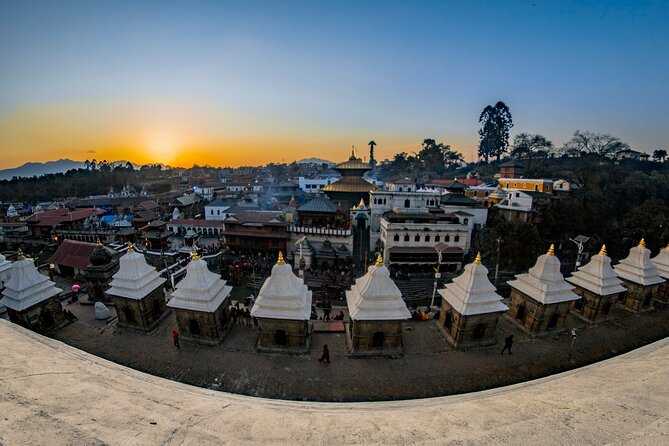
At Gorakhnath Mandir, the group takes a rest and hears the story of Guru Gorakhnath. The stop lasts about 30 minutes, including the onward route and explanation. This provides another look at Hindu spiritual traditions beyond the main temple complex.
The journey then continues through Guhyeshwari Temple, a Shaktipeeth associated with the story of Satidevi. Your guide explains the Shaktipeeth concept and its place in Hindu belief. The listed visit is about 20 minutes, followed by roughly 20 minutes to reach Boudhanath.
These stops are useful if you want more than the standard Pashupatinath highlights. They also make the route feel like a religious walk through a living part of Kathmandu rather than a simple temple transfer. The tradeoff is time. Every added stop leaves less room for a long visit at the stupa, so tell your guide if Boudhanath is your main priority.
Boudhanath Stupa and the basics of Buddhism
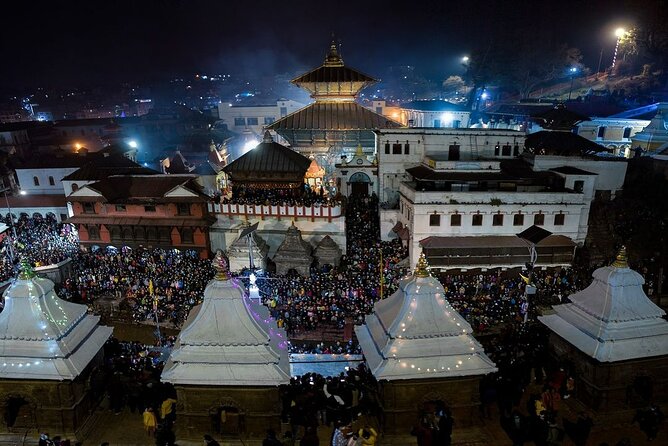
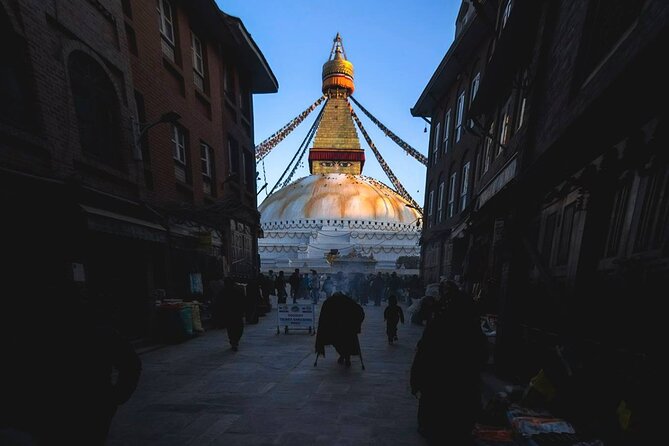
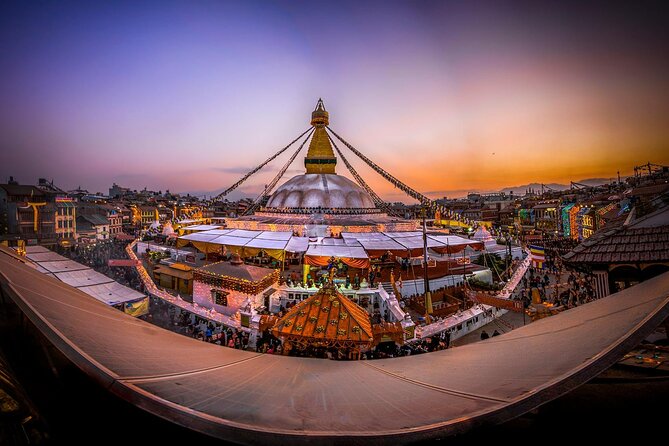
Boudhanath is the tour’s second major focus. The visit lasts about 45 minutes and introduces Tibetan Buddhism, also called Vajrayana Buddhism, through the symbolism and practices visible around the stupa.
You will learn about prayer flags, the five elements, the Four Noble Truths, and the Eightfold Path. These are not just abstract terms. The guide connects the ideas to the physical setting, helping you understand why people come here, how Buddhist prayer works, and what the stupa represents.
Boudhanath is also a place where the tour’s theme of religious harmony becomes clear. The route has moved from Hindu temples and cremation rites into a Buddhist center, yet both traditions are part of the same Kathmandu setting. The guide also discusses the cultural exchange between communities, including connections in local food and daily life.
The 45-minute stop is enough for a useful introduction, but not enough for every detail. If you want quiet time to walk around the stupa, take photographs, shop, or sit with the atmosphere, plan to stay after the tour ends. The official finish is at the Boudhanath Gate, so you are free to continue on your own.
Guru Lhakhang Monastery and Buddhist practice
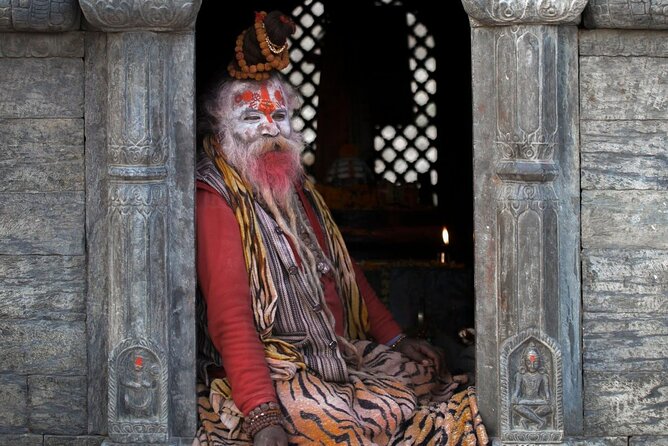
Guru Lhakhang Monastery gives you a short look inside a typical Buddhist monastery. The stop takes about 10 minutes and includes discussion of Guru Padmasambhava and Dharma Chakra Pariwartana.
Because the visit is brief, it works as a focused introduction rather than a full monastery tour. You get a sense of how Buddhist religious spaces are arranged and hear about figures and teachings important to Tibetan Buddhism.
I find this stop particularly useful for first-time visitors who might otherwise see the colorful exterior of a monastery without understanding its purpose. Keep your expectations realistic: the schedule allows for a short explanation, not an extended meditation session or detailed art study.
Thangka painting, mandalas, and healing bowls
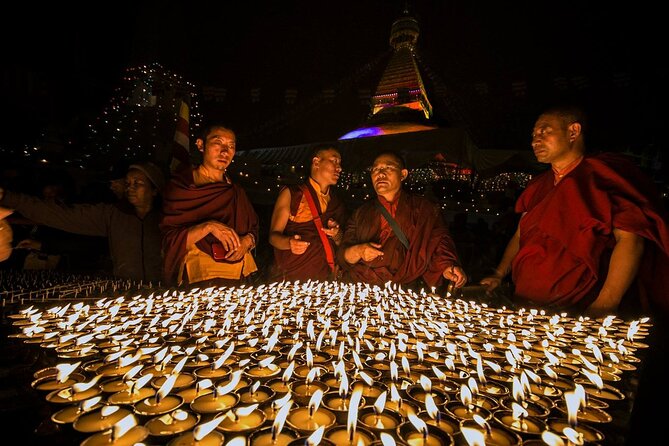
The final stop is the Boudha Stupa Thangka Center, where you learn about Thangka painting and the idea of the mandala. Thangka art is detailed Buddhist religious painting, and the center or school gives you a chance to see how this tradition is taught.
The guide also introduces the basics of healing bowls. This adds an artistic and sensory element after the more theological discussion at Boudhanath. If you like symbols, visual detail, and craft traditions, this may be one of the most memorable parts of the route.
The tour ends near the Boudhanath Gate after this stop. You can stay in the area, return to your accommodation, or continue sightseeing independently. Ending here is practical because Boudhanath is already a destination worth more time than the scheduled visit allows.
The guide makes the difference
This experience depends heavily on the person leading it. Santosh receives the strongest praise for clear explanations, patience, flexibility, and broad knowledge of religion, history, archaeology, culture, and food. He has also adjusted the schedule for special requests and for a guest who was not feeling well.
Shreya has also led city visits connected with Kathmandu and Bhaktapur, explaining local people, culture, and history while allowing time for personal interests. Guide assignments are not guaranteed in the information provided, so if you specifically want Santosh, ask the operator, Amazing Kathmandu Tours, before booking.
A small group helps here. With no more than five people, you can ask why a symbol appears on a temple, what a ceremony means, or how Hindu and Buddhist customs relate. That is a far better setup for religious sites than a large group where the guide must keep moving.
Cost, timing, and practical details
The listed price is $15 per person, with group discounts available. The tour accepts mobile tickets and confirmation arrives at booking. The schedule lasts about three hours.
Entrance fees are separate and paid in cash: about NRP 1,000, or $9, for Pashupatinath, and NRP 400, or $4, for Boudhanath. At roughly $28 total, the outing is still good value if you want cultural interpretation and a small group, but the extras should not surprise you.
The tour starts at Gaushala Bus Stop and ends at Buddha Stupa, near the Boudhanath Gate. It is close to public transportation, and most people can take part. Service animals are allowed.
Free cancellation is available if you cancel at least 24 hours before the start time. Cancellations or changes made within 24 hours are not refunded or accepted.
Who should book this experience
I would choose this tour if you are new to Kathmandu and want a clear introduction to Hinduism and Buddhism in one morning or afternoon. It also suits you if you prefer asking questions rather than simply following a guide from one monument to the next.
It is a good fit for culturally curious visitors, solo visitors who want company, couples, and small families. The maximum group of five keeps the outing personal without the cost of a fully private guide.
You should think twice if you dislike discussions of death or active cremation sites. You should also book with the understanding that the $15 price excludes two notable entrance charges, and that the three-hour schedule leaves limited time for independent exploration.
Should you book Pashupatinath and Boudhanath?
Yes, if you want the meaning behind Kathmandu’s religious sites, not just a series of photographs. The combination of Aryaghat, Hindu rites, smaller temples, Boudhanath’s Buddhist teachings, a monastery, and Thangka art gives you a useful foundation for the rest of your time in Nepal.
The best reason to book is the guide-led interpretation, especially if Santosh is available. Ask about guide assignment and ceremony timing before confirming. Also bring cash for the entrance fees, allow for a serious moment at the crematorium, and save extra time after the tour to explore Boudhanath on your own.
FAQ
How long does the Pashupatinath and Boudhanath tour last?
The tour lasts approximately three hours.
How many people can join the tour?
The group has a maximum of five participants.
Can non-Hindus enter Pashupatinath Temple?
No. Only Hindus may enter the main temple. The tour passes by the temple and continues toward Aryaghat, where the guide explains Hindu rites and traditions.
Are entrance fees included?
No. Pashupatinath costs about NRP 1,000 and Boudhanath about NRP 400. Both fees are paid in cash at the entrance.
Where does the tour start and finish?
It starts at Gaushala Bus Stop on Ring Road in Kathmandu and ends at the Boudhanath Gate, near Buddha Stupa.
Can I cancel for a full refund?
Yes. You can cancel at least 24 hours before the experience start time for a full refund. Cancellations and changes made within 24 hours are not refunded or accepted.
More Small Group Tours in Kathmandu
- Monkey Temple – Swayambhunath Tour – Private/Small Group
★ 5.0 · 50 reviews - Patan Heritage Tour – Private/Small Group
★ 5.0 · 14 reviews - Kathmandu Durbar Square – Private/Small Group
★ 5.0 · 13 reviews
Recently added around Kathmandu
- Kathmandu Airport Pickup and Drop-off Services★ 5.0 · 3 reviews
- Kathmandu Paragliding★ 5.0 · 3 reviews
- Kathmandu Chandragiri Cable Car and Swayambhunath Private Tour★ 5.0 · 3 reviews
- Explore The Beauty Of Langtang Valley In 8-Days Trek★ 5.0 · 3 reviews
- Kathmandu: Nightlife and Pub Crawl Tour★ 5.0 · 3 reviews
- Kathmandu: Momo Making Class with a Local Chef★ 5.0 · 3 reviews
- Mountain Flight Experience in Nepal★ 4.5 · 3 reviews
- Everest Base Camp Trek★ 5.0 · 3 reviews
Other Pashupatinath Tours worth a look
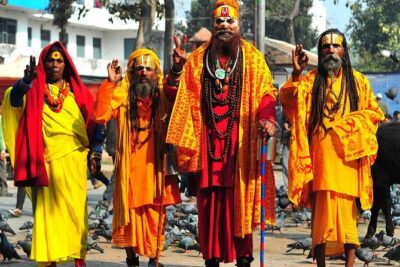
Kathmandu Spiritual Sites: Bodhnath & Pashupatinath Tour
Read our review →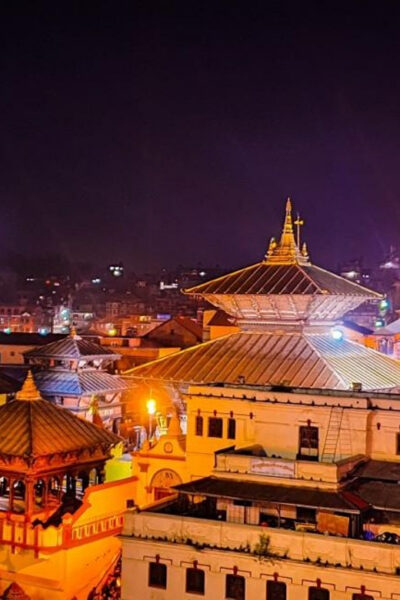
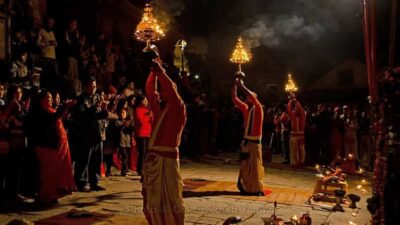
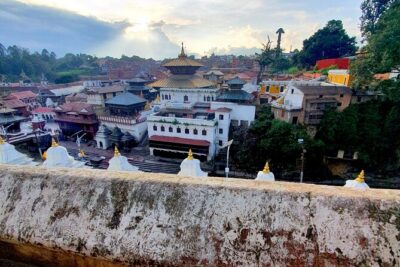
Pashupatinath Temple, Hindu Crematorium and Aarati in-depth Tour
Read our review →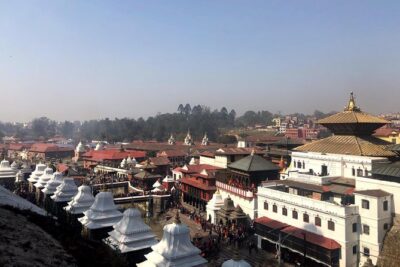
Pashupatinath Evening Aarati: Few Divinely Hours in Kathmandu
Read our review →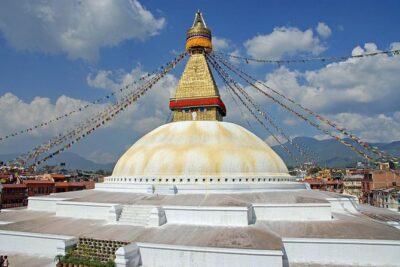
Private Half-Day Tour of Boudhanath and Pashupatinath Temples in Kathmandu
Read our review →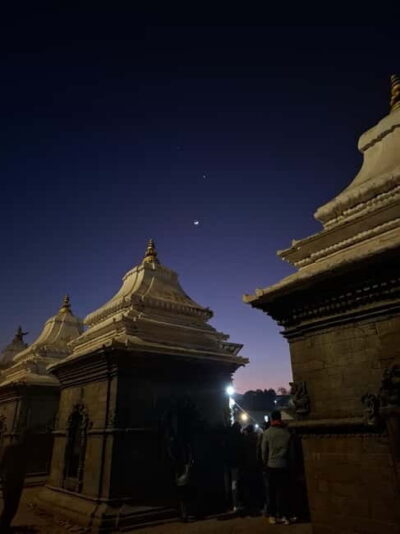
Katmandu: Pashupatinath Open Cremation & Evening Aarati
Read our review →This tour also appears in