
REVIEW · ANNAPURNA CIRCUIT TREKS
20 Days Annapurna Circuit Trek
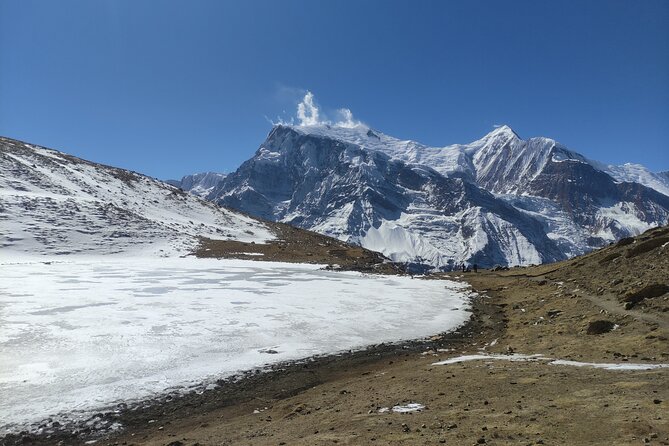
The great appeal here is the rapid change in scenery. In 20 days, you move from Kathmandu’s temples and crowded streets to subtropical forest, high mountain villages, dry valleys, and the icy crossing of Thorong La Pass at 5,416 meters. The route also gives you real time in Manang, where a rest day matters far more than another rushed viewpoint.
I especially like the mix of cultural stops and mountain walking, from Pashupatinath and Boudhanath to Muktinath and the villages along the Kali Gandaki River. I also like that a licensed guide, porter support, permits, airport transfers, and many meals are included. The main concern is the demanding transport and schedule: the drive to Syange can take about 10 hours, and several trekking days run five to seven hours.
Key points to know before you book
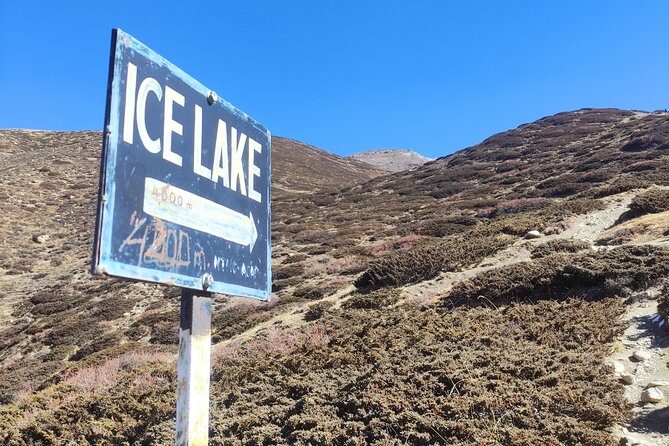
- Thorong La is the physical high point: The 5,416-meter pass requires an early start, steady pacing, and respect for altitude.
- Manang gets a full acclimatization day: You spend Day 8 exploring rather than climbing higher.
- The scenery changes dramatically: Forest, farmland, snowy peaks, dry high valleys, and the Kali Gandaki corridor all appear on one route.
- Poon Hill adds a sunrise finish: A weather-dependent morning climb reaches 3,195 meters for views toward Dhaulagiri, Annapurna, and Manaslu.
- The $1,200 price covers useful basics: Guide, porter arrangement, permits, transport, airport transfers, and 48 listed meals are included.
- The route is private: Only your group participates, which allows more control over walking pace and rest stops.
Why the Annapurna Circuit still earns 20 days
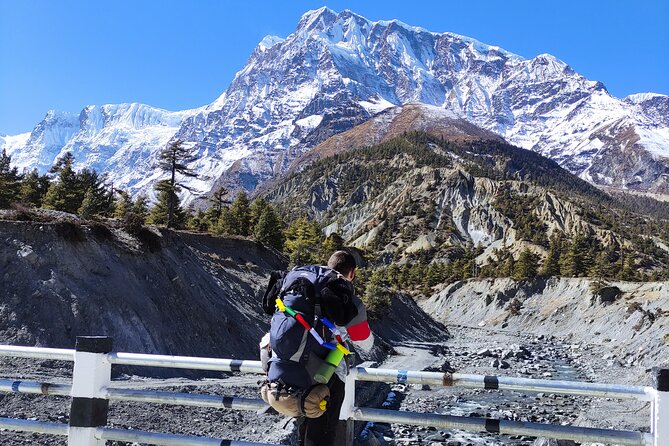
The Annapurna Circuit is a long mountain route around the Annapurna massif, covering roughly 160 to 230 kilometers depending on the exact trail and road sections used. Its appeal is not one single view. It is the changing rhythm of the journey.
Near the lower elevations, you walk through farm terraces, waterfalls, steep hills, and warm forests. Higher up, trees thin out and the country becomes dry and wind-swept. The snowy peaks remain close, but the villages, weather, and feel of the route change from day to day.
That variety gives this trek an advantage over a short out-and-back walk. You are not simply going up and returning by the same path. You are crossing a major mountain pass, entering a different river valley, and finishing among the lower foothills near Pokhara.
You should also understand what this is not. It is not a luxury lodge holiday, and it is not a gentle sightseeing trip with a little walking added. The itinerary includes long road transfers, basic trekking accommodation, early starts, and several days at altitude. The reward is a more complete experience of Nepal, but you need to arrive ready for sustained effort.
More Annapurna Circuit Treks in Kathmandu
- Annapurna Circuit Trek with Tilicho Lake
★ 5.0 · 368 reviews - Annapurna Circuit Trek
★ 5.0 · 94 reviews - Annapurna Circuit Trek
★ 5.0 · 35 reviews
Kathmandu begins with temples and practical preparation
Day 1 is simple but useful. A representative meets you outside Tribhuvan Airport and takes you to your hotel. The airport pickup removes one early nuisance, especially if this is your first visit to Kathmandu.
Day 2 is a full sightseeing day by car. At Pashupatinath Temple, on the Bagmati River, you see one of Nepal’s most important Hindu religious sites. The visit lasts about two hours, but the entrance fee is extra, listed at NPR 1,000 for foreign nationals and free for Indian visitors.
Boudhanath Stupa brings a calmer mood. Its large Buddhist dome and watchful painted eyes make it one of Kathmandu’s most memorable places. Plan on about an hour here, with an entry charge of NPR 400 for foreign nationals and NPR 100 for SAARC and BIMSTEC nationals.
Kathmandu Durbar Square adds palaces, courtyards, and carved architectural details. You have about two hours, and the listed entry fee is NPR 1,000 for foreign nationals or NPR 500 for SAARC and BIMSTEC nationals.
I like this arrangement because the city visit gives you cultural context before the mountains begin. Still, the day is full. You will be on your feet after arriving in Nepal, and the sightseeing fees are not part of the package, so keep some local currency available.
The long road to Syange tests your patience
Day 3 is mostly transport. You travel from Kathmandu toward Besisahar, then continue by shared jeep to Syange, at about 823 meters. The total drive is listed at roughly 10 hours.
This is the least glamorous part of the trip, but it is part of the modern Annapurna route. Roads now reach places that once required much longer walks, allowing you to complete the circuit in 20 days rather than spending many extra days on lower trails.
The tradeoff is comfort. A regular bus from Kathmandu to Besisahar followed by a shared jeep is practical, not plush. The mountain roads and long sitting time can be tiring. I would treat this day as a patience exercise, not a sightseeing highlight.
Syange to Manang brings the mountains closer
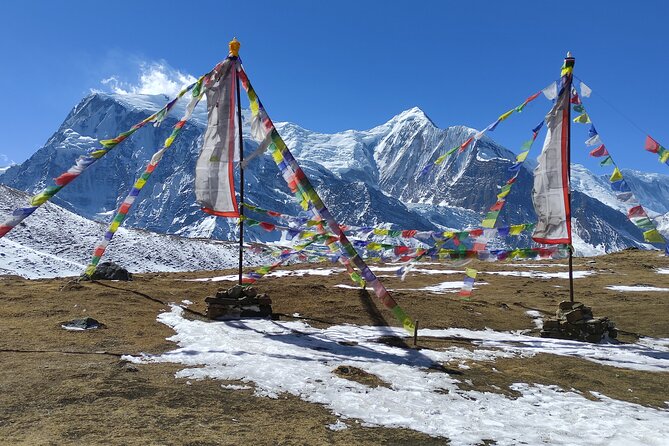
From Syange, the walking begins in earnest. Day 4 leads toward Dharapani, with gorge scenery, waterfalls, high hills, and farm terraces. The first section is steep for about half an hour, then the route continues through greener surroundings. The stated walking time is about six hours.
On Day 5, you walk from Dharapani to Chame. Vegetation begins to change, the air cools, and forest replaces some of the warmer lower-country growth. Bagarchhap is an important early village, known in the itinerary for its Tibetan-style character. This is where the circuit starts to feel more distinctly Himalayan.
Day 6 takes you from Chame to Pisang, at about 3,200 meters, in five to six hours. The trail follows the river on its northern bank after leaving Chame. By now, the snowy peaks become a steady companion rather than a distant backdrop.
The walk from Pisang to Manang on Day 7 takes about five hours. After a gentler opening, the trail climbs more sharply for roughly half an hour. The reward is a stronger mountain setting and wide views of snow-covered summits.
Manang deserves its rest day. On Day 8, you stay at about 500 flat-roofed houses surrounded by Annapurna, Gangapurna, Tilicho, and other high peaks. The itinerary describes this as an acclimatization day, and that is one of the trip’s best planning choices. You can explore the village without the pressure of advancing to a higher sleeping point.
You should not think of this as a wasted day. At altitude, allowing your body to adjust is part of making the pass crossing safer and more enjoyable. The schedule gives you room to appreciate Manang instead of treating it as a place to sleep and leave.
More Hiking Tours in Kathmandu
- Everest Base Camp Trek – 14 Days
★ 5.0 · 1,499 reviews - Everest Base Camp Trekking
★ 5.0 · 485 reviews - Nagarkot Sunrise View and Day Hiking from Kathmandu
★ 5.0 · 471 reviews - Everest Base Camp Trekking – 13 Day
★ 5.0 · 365 reviews
Yak Kharka and Thorong High Camp mark the serious climb
Day 9 takes you from Manang to Yak Kharka in about five hours. The trail rises gradually, with views toward Annapurna II, Gangapurna, Tilicho, and the Chulu peaks. The route becomes increasingly barren and exposed as you gain height.
Day 10 continues toward the Thorong High Camp viewpoint. The walking time is about six hours, and the trail climbs slowly past Ledar, the last settlement mentioned before the pass approach. This is a day for conserving energy. The point is not to race uphill, but to arrive ready for the pass crossing.
The high country can feel stark. Trees become scarce, wind matters more, and the path may feel tougher than the distance suggests. You need warm layers, water, sun protection, and enough patience to take a slow pace.
Thorong La and Muktinath are the trip’s defining day
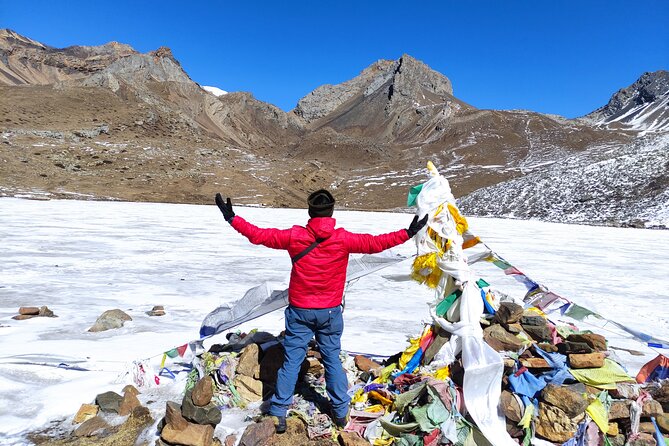
Day 11 begins early. You need to reach the top of Thorong La before cold winds strengthen, so breakfast and departure happen at an uncomfortable hour. The climb is steep at first and strenuous throughout, but the pass at 5,416 meters is the great physical achievement of the route.
The crossing is not just a photo stop. It is the highest point of the trek, and altitude affects people differently. The itinerary provides an acclimatization day in Manang, but no schedule can remove the need to pay attention to how you feel. Follow your guide’s instructions and keep your pace steady.
From the pass, the route descends to Muktinath at about 3,800 meters. The descent takes about three hours after the pass section, and the whole day is described as the longest trekking day. Muktinath is a sacred site important to both Hindu and Buddhist traditions, adding religious meaning to an already dramatic day.
This is where the itinerary’s natural and cultural sides meet best. You cross a high Himalayan pass, then arrive at a pilgrimage village with its own long-standing traditions. Expect to be tired. A long descent after a high climb can be hard on knees and feet.
Marpha and the Kali Gandaki corridor change the mood
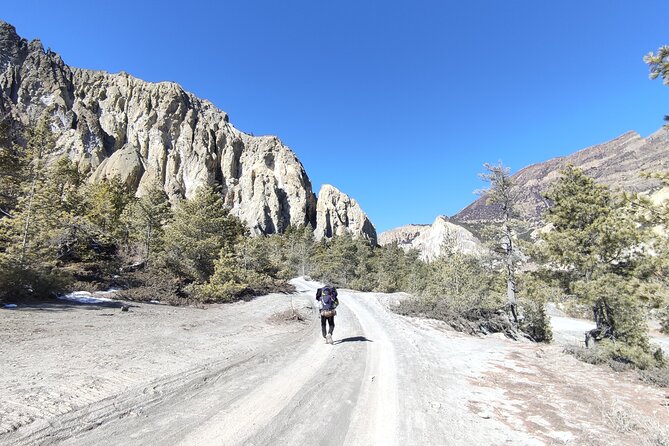
From Muktinath, Day 12 descends about 1,200 meters to the Kali Gandaki River valley. You pass Ekale Bhatti, whose name means lonely teahouse, and continue toward Marpha in about five hours.
The change is striking. The high country around Muktinath is dry and open, while the river valley provides a different sense of shelter and movement. Marpha is a natural pause after Thorong La, with the trail now running downhill rather than toward another major height.
Day 13 leads from Marpha to Lete in about six hours. The route follows the Kali Gandaki downstream through Tukuche, below Tukuche Peak and Dhaulagiri. You get some of the trek’s most powerful mountain views here, with enormous peaks rising above the river corridor.
Day 14 continues to Tatopani, again in about six hours. The dry country gradually gives way to pine and conifer forest. The trail passes between Dhaulagiri and Annapurna, then follows a greener setting as it loses altitude.
Tatopani is especially welcome because it marks the return to warmer country. The itinerary does not list extra accommodation or special services here, so do not assume luxury. Think of it as a comfortable-feeling stop because of the lower elevation and changing vegetation, not because the package promises a spa stay.
Ghorepani and Poon Hill provide a strong second act
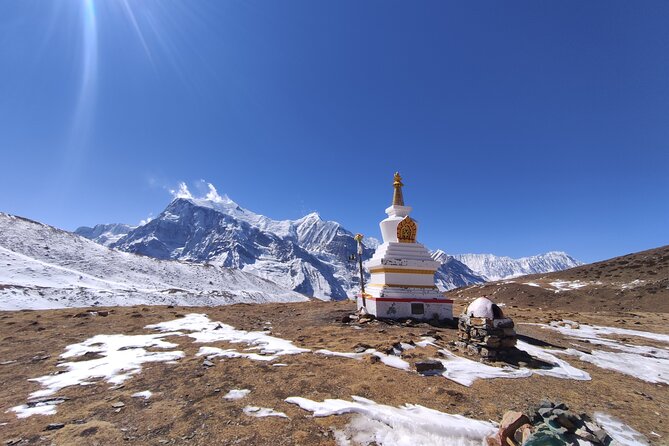
Day 15 climbs from Tatopani to Ghorepani, at about 2,860 meters. The walk takes six to seven hours and includes a suspension bridge over the Kali Gandaki. The path then rises through rural farmland and forest.
This is a demanding day because the route climbs again after several days of descent. You have already crossed Thorong La, but that does not mean the walking is over. Ghorepani is a useful base for the next morning’s viewpoint.
Day 16 starts with an optional, weather-dependent hike to Poon Hill, at 3,195 meters. The climb takes about an hour and aims for sunrise views across Dhaulagiri, Annapurna, and the Manaslu range. Weather controls the payoff, so keep expectations flexible.
Poon Hill is a smart addition to the circuit. It gives you a final high viewpoint without requiring another major pass, and the early start creates a memorable contrast with the long walking days. After sunrise, you descend toward Tikhedhunga in about five hours.
The itinerary then lists Day 17 as a seven-hour route to Pokhara, passing farm villages and waterfalls. This section needs clarification when you book, since the exact walking and transfer arrangements are not fully spelled out. Ask if the day includes a road transfer after the trek and where the walking officially ends.
Pokhara offers breathing room before Kathmandu
Day 18 is a leisure day in Pokhara. You can use it to rest, or visit Phewa Lake, Begnas Lake, and Rupa Lake. After nearly two weeks of mountain walking, this pause is valuable. It also gives you a buffer before the return to Kathmandu.
Day 19 is an approximately eight-hour drive back to Kathmandu. The route follows scenic hills and views of the Trisuli and Marsyangdi rivers. As on the outbound journey, the road time can be tiring, but it lets you see the country from a different angle.
Day 20 brings an airport transfer about three hours before your scheduled international flight. Make sure your flight details are correct and allow the company enough notice for the transfer.
What the $1,200 price really covers
At $1,200 per person, the package offers solid practical value for a private 20-day trek, provided you understand what is included. Airport pickup and drop-off, Kathmandu sightseeing by car, the Kathmandu to Besisahar bus, the shared jeep to Syange, a licensed trekking guide, porter support, ACAP, and TIMS are included.
The porter arrangement is one porter for two guests, carrying a maximum of 25 kilograms. That is useful, but you should still pack carefully and confirm how your bags will be divided between the two people sharing the porter.
Meals include 18 breakfasts, 15 lunches, and 15 dinners. Drinks are not included, including soft drinks and alcoholic drinks. The meal count also means you should check exactly which nights and travel days are covered before departure.
Accommodation is not described in detail, and special accommodation costs extra. Ask what standard lodging is planned in Kathmandu, along the trek, in Pokhara, and on the return. Rescue and evacuation costs are also excluded, so travel insurance with high-altitude trekking and evacuation coverage is essential.
You will also pay for your Nepal visa, international flights, personal expenses, staff tips, drinks, and the three Kathmandu attraction fees. These extras do not erase the value of the package, but they make the real trip cost higher than $1,200.
Who should book this trek
This trip suits you if you want a classic Annapurna route with a private group, structured support, and a strong mix of nature and culture. A moderate fitness level is required, but the itinerary still includes long days, steep climbs, high altitude, and a major pass.
It is a good choice for someone who wants a guide and porter without paying for a high-end trekking package. The private format is useful if your group wants to control its pace, though the fixed itinerary still leaves limited room for major changes.
I would be cautious if you dislike long bus rides, basic mountain accommodation, or early starts. I would also ask detailed questions if you have limited hiking experience at altitude. The company’s past trips have included staff such as guide Jaya and porters Malik and Dinesh, but this itinerary does not assign a named guide, so confirm who will lead your group.
Cancellation is flexible up to three full days before the local start time. After that point, the amount paid is not refunded, and late changes are not accepted.
Should you book the 20-day Annapurna Circuit?
Book it if your priority is a broad Nepal experience: temples in Kathmandu, a full circuit through changing mountain country, Thorong La, Muktinath, Poon Hill, and time in Pokhara. The included guide, permits, porter arrangement, transfers, and many meals make $1,200 a reasonable starting price.
Before paying, confirm the accommodation standard, the exact Day 17 transfer plan, meal coverage, and the name and experience of your guide. If those details suit you, this is a practical way to tackle one of Nepal’s great long-distance treks without organizing every permit, vehicle, and porter yourself.
FAQ
How long is the Annapurna Circuit trek?
The experience lasts approximately 20 days. The route covers roughly 160 to 230 kilometers, depending on the exact trail and road sections used.
What is the highest point on the trek?
The highest point is Thorong La Pass at 5,416 meters. The pass is crossed on Day 11 after an early morning start.
Is airport pickup included?
Yes. Airport pickup on arrival and airport drop-off before your flight are included. The airport representative is scheduled to meet you outside Tribhuvan Airport, and the final transfer is planned about three hours before departure.
Are meals included?
Yes. The package includes 18 breakfasts, 15 lunches, and 15 dinners. Drinks, including soft drinks and alcoholic drinks, are not included.
Are trekking permits included?
Yes. The Annapurna Conservation Area Project permit and TIMS card are included.
What fitness level is required?
The experience states that you should have a moderate physical fitness level. The schedule includes five to seven-hour trekking days, a long day crossing Thorong La, steep sections, and walking at high altitude.
Recently added around Kathmandu
- Kathmandu Airport Pickup and Drop-off Services★ 5.0 · 3 reviews
- Kathmandu Paragliding★ 5.0 · 3 reviews
- Kathmandu Chandragiri Cable Car and Swayambhunath Private Tour★ 5.0 · 3 reviews
- Explore The Beauty Of Langtang Valley In 8-Days Trek★ 5.0 · 3 reviews
- Kathmandu: Nightlife and Pub Crawl Tour★ 5.0 · 3 reviews
- Mountain Flight Experience in Nepal★ 4.5 · 3 reviews
- Kathmandu: Momo Making Class with a Local Chef★ 5.0 · 3 reviews
- Everest Base Camp Trek★ 5.0 · 3 reviews
Other Annapurna Circuit Treks worth a look

15-Day Private Annapurna Circuit Trek from Kathmandu
Read our review →
This tour also appears in