
REVIEW · ANNAPURNA CIRCUIT TREKS
10 Days Annapurna Circuit Trek
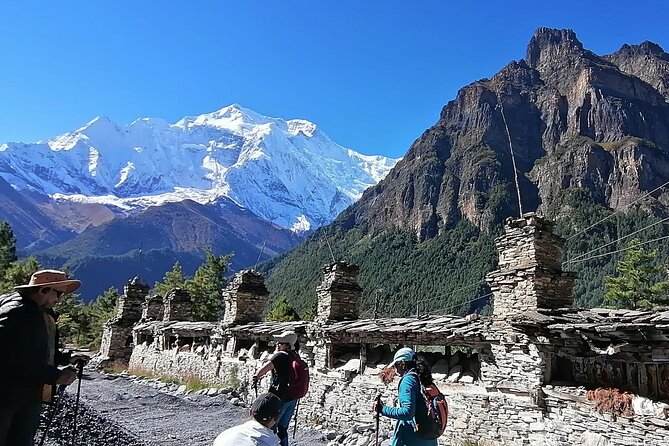
The big draw here is Thorong La Pass at 5,416 meters, reached after days of walking through pine forest, high valleys, Tibetan-style villages, and the dry Mustang region. You also get the cultural shift from Kathmandu and Hindu pilgrimage sites to Manang’s mountain life and Muktinath’s sacred setting.
I like the practical all-in-one setup: a porter for every two people, meals throughout the trek, a sleeping bag, private transport, and the Jomsom to Pokhara flight are included. I also like that Manang gets a full exploration day, with Gangapurna Lake and time to see how people live at altitude.
The catch is the pace. Ten days is short for a route with a very high pass, and several walking days are strenuous. The itinerary also includes a long first drive and basic mountain accommodation, so this suits you best if you have moderate fitness, a flexible attitude, and a real appetite for mountain walking.
Key points at a glance
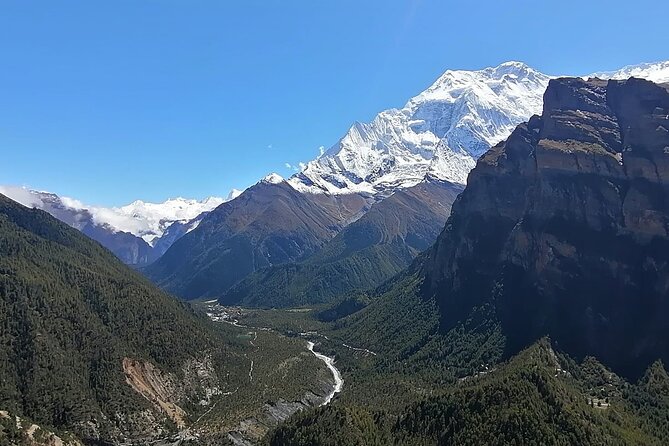
- Thorong La Pass reaches 5,416 meters, the trek’s highest point and its toughest test.
- Manang gets a full day, including a visit to Gangapurna Lake and time in the village.
- One porter is assigned to every two people, which keeps your personal load more manageable.
- Meals, a sleeping bag, transport, and the Jomsom to Pokhara flight are included in the $1,430 price.
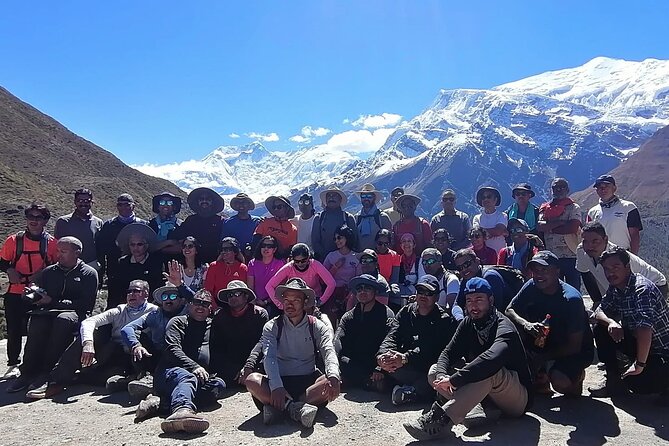
- The group is capped at 15 people, a useful size for a narrow mountain trail.
- Guides named in the company’s trek feedback include Babu and Resham, with porter Rojit also praised for friendly, attentive help. Ask who will lead your departure before booking.
Why the Annapurna Circuit still earns its reputation
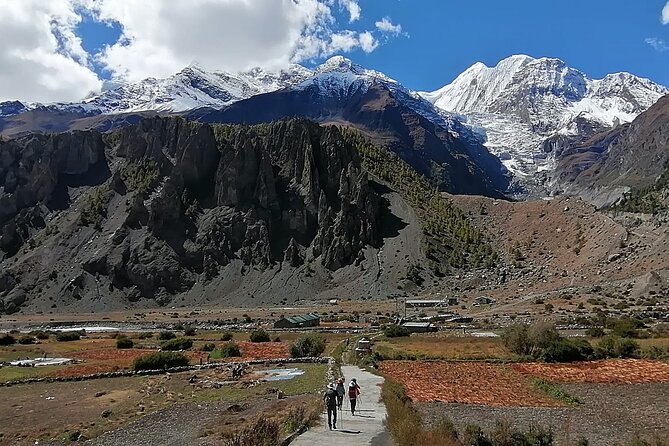
The Annapurna Circuit works because the scenery keeps changing. You begin with a long road journey from Kathmandu, then move into river valleys and forest. Later, the trees thin out, the air feels more severe, and the route takes on a dry, Tibetan character.
That change matters. You are not simply walking toward one viewpoint. You are crossing a whole mountain region, with villages, temples, bridges, river corridors, steep slopes, and huge peaks appearing in stages.
The advertised distance is roughly 160 to 230 kilometers, or about 100 to 145 miles, depending on the exact route and road sections. This is a serious trek, even though parts of the traditional circuit now include vehicle access. The 10-day plan keeps the schedule tight, so you should expect full walking days rather than leisurely village strolls.
The strongest cultural moments are Manang and Muktinath. Manang offers a close look at high-altitude village life. Muktinath brings a religious dimension, with a temple that is important in the Mustang region. These stops give the trek more meaning than a simple mountain workout.
More Annapurna Circuit Treks in Kathmandu
- Annapurna Circuit Trek with Tilicho Lake
★ 5.0 · 368 reviews - Annapurna Circuit Trek
★ 5.0 · 94 reviews - Annapurna Circuit Trek
★ 5.0 · 35 reviews
Day 1: Kathmandu to Besisahar by road
Your staff picks you up around 7:00 am, with the activity start listed as 7:15 am from the Himalayan Trekking and Tours office on Yapikhya Marg in Kathmandu. The drive to Besisahar covers about 185 kilometers and takes around seven hours.
This is not a glamorous opening. It is a long road day, and you should treat it as part of the approach rather than part of the trek itself. The reward comes at the end, when you reach Besisahar and begin to see the mountains more clearly.
The itinerary also includes Manakamana Temple on this first day. That gives the journey an early spiritual stop and breaks up the road trip. Admission is listed as free, though the provided information does not spell out every detail of the visit.
The first day is useful because private transport keeps the group together and removes the need to arrange a separate transfer. Still, seven hours in a vehicle can feel tiring before you have taken a single trekking step. Pack water and snacks, since bottled water is not included.
Days 2 and 3: Forest, bridges, and the approach to Chame
The route begins to feel like a proper Himalayan trek on Day 2. It climbs toward Tyanja at about 2,360 meters, then continues through forest and along the river toward Kopar at around 2,590 meters before reaching Chame, headquarters of Manang district.
Chame is a good early turning point. The forest and river setting still feel relatively enclosed, while views of Annapurna II begin to open the valley. You get a clear sense that the route is moving into higher country.
Day 3 follows a deep, narrow valley through thick forest. The trail crosses a long bridge at about 2,910 meters, then another bridge at 3,040 meters. The rock face of Paungda Danda becomes a major visual feature, rising sharply beside the route.
These bridges and narrow paths add drama, but they also show why sensible footwear and steady footing matter. The route is not described as technically climbing, yet steep valley sections and uneven ground can be tiring. Your guide’s role is important here, especially when the trail narrows.
The scenery on these days is close and powerful. You are surrounded by forest, rock, river, and high peaks rather than wide open views at every turn. That variety keeps the walk interesting.
Day 4: Pine forest and the first great mountain views
On Day 4, aromatic pine forest gives way to grander views as the trail approaches Manang. You can expect close views of Gangapurna, Annapurna II and III, Tilicho, Chulu East, and Pisang Peak.
This is one of the route’s best visual transitions. Earlier, the valley and trees often control your view. Near Manang, the mountains take over. The peaks feel closer, larger, and more connected to the villages below.
You should not rush this section. The mountain views are one of the main reasons to choose the circuit, and the day gives you a chance to stop, breathe, and take them in. At the same time, altitude is becoming a larger factor, so the effort may feel greater than the distance suggests.
The itinerary does not provide exact walking times for every day. That makes it hard to judge the daily mileage precisely. If you are comparing this trip with another 10-day circuit, ask the operator for the planned walking hours and overnight elevations before paying.
More Hiking Tours in Kathmandu
- Everest Base Camp Trek – 14 Days
★ 5.0 · 1,499 reviews - Everest Base Camp Trekking
★ 5.0 · 485 reviews - Nagarkot Sunrise View and Day Hiking from Kathmandu
★ 5.0 · 471 reviews - Everest Base Camp Trekking – 13 Day
★ 5.0 · 365 reviews
Day 5: Manang and Gangapurna Lake
A full day in Manang is a major strength of this schedule. Instead of pushing onward every morning, you have time to explore the village and visit Gangapurna Lake.
This pause gives you more than a scenic photo. It lets you see local mountain life at a slower pace, interact with people in the village, and adjust to the increasing altitude before the hardest part of the route.
The supplied timing for this day says 20 hours, which is clearly inconsistent with a normal exploration day. Treat it as a full-day Manang stop, not as a 20-hour walking program.
Gangapurna Lake is a memorable destination because it brings together ice, rock, water, and towering peaks. The visit also adds variety to the trek. After several days of forward motion, you get a chance to look around rather than simply count the next rise in the trail.
This is the day I would value most from an altitude perspective, although the provided plan does not promise a specific acclimatization program. If you have had altitude problems before, discuss your concerns with the company in advance. One piece of trek feedback describes guides helping when altitude trouble appeared, but you should still take responsibility for your health and tell your guide early if you feel unwell.
Day 6: Manang to Yak Kharka and Ledar
Leaving Manang, the trail climbs through the Marshyangdi Valley toward Gunsang, Yak Kharka, and finally Ledar before sunset. The route becomes more exposed and demanding as the trees recede.
This is where the trek begins to feel properly high. The walking may not always be steep, but the altitude can make ordinary uphill sections feel slow. Keep your pace even and avoid treating the day as a race.
Yak Kharka and Ledar are practical overnight points before the pass. They place you closer to Thorung Phedi, but the trade-off is simple mountain lodging and fewer comforts than you would expect in a city hotel.
The price includes breakfast, lunch, and dinner for the listed 10 days, along with a sleeping bag. That takes care of the main daily needs, but bottled water is not included. Carry money for drinks and personal purchases, and remember that alcohol is also excluded.
Day 7: The rough approach to Thorung Phedi
Day 7 follows the east bank of the Jorsang Khola toward Thorung Phedi. The trail is described as tough, with narrow sections and unstable slopes.
This is not the day to carry an oversized pack. The porter arrangement, one porter for two people, is especially useful here. You still need to manage your daypack, but your main luggage can be handled for you.
Thorung Phedi is the staging point for the pass crossing. Overnighting here means you are positioned for an early start on the most demanding day. The provided details do not give a precise departure time for the pass, so confirm the schedule with your guide.
The route’s wording about unstable slopes deserves attention. That does not mean the trek is unsuitable, but it does mean you need to watch your footing and follow local instructions. Weather can affect high mountain conditions, so flexibility is part of the deal.
Day 8: Thorong La Pass and Muktinath
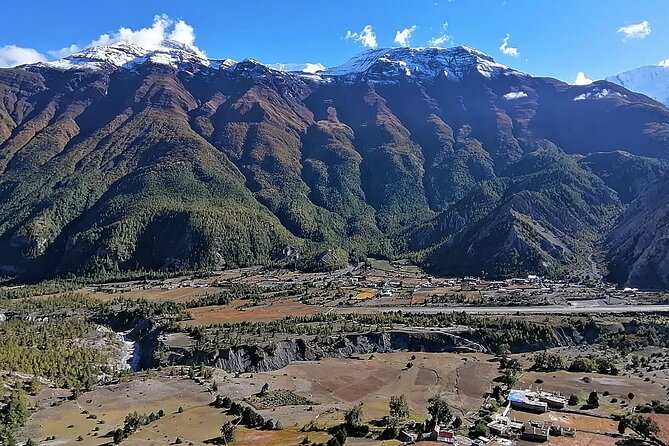
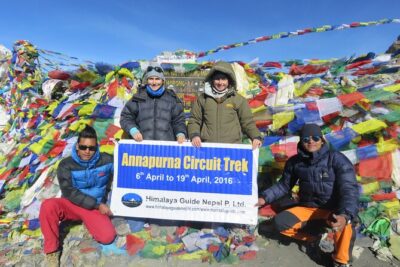
Day 8 is the centerpiece. You climb toward Thorong La Pass at 5,416 meters over rocky ridges, then descend toward Muktinath.
From the pass, you can see the Dhaulagiri range. The high point is physically demanding, but it also delivers the clearest sense of crossing from one side of the Annapurna region to another. Reaching the top is a genuine achievement, not just another stop on a sightseeing program.
The pass is listed with an admission fee that is not included. Muktinath also has an admission fee listed as not included. These are small but useful budget details, since the headline price does not cover every possible charge.
The descent to Muktinath changes the mood quickly. The route moves from rocky high ridges into the Mustang region, where the setting is drier and the villages have a Tibetan influence. Muktinath Temple adds a powerful religious stop after the physical challenge of the pass.
The itinerary allows only 15 minutes at Thorong La and 10 minutes at Muktinath in its stop listings. Those times may describe recorded stop durations rather than the entire walking schedule, but they are still worth clarifying before booking. You will want enough time to rest at the pass and experience Muktinath without feeling hurried.
Day 9: Down the Kali Gandaki Valley
The route descends through the dramatic Kali Gandaki Valley, with arid scenery replacing the greener valleys of the lower circuit. It passes through Jharkot and Khingar, described as typical Tibetan villages, before following the valley floor toward Jomsom.
This day is a welcome change after the pass. Descending generally feels easier on the lungs, though it can be hard on knees and ankles. Trekking poles may be useful, but the supplied information does not list them among the inclusions, so bring your own or ask the operator about rental options.
Jharkot and Khingar are valuable because they show the region’s architecture and culture in a setting that feels very different from Manang. The trek is no longer just about snow peaks. It is also about how communities adapt to dry, high valleys.
Jomsom is important for the final transport connection. Your next day depends on the morning flight to Pokhara, so keep your belongings organized and confirm the flight plan with the guide.
Day 10: Jomsom to Pokhara and Fewa Lake
After breakfast, you take a morning flight from Jomsom to Pokhara. The flight passes above the Kali Gandaki Gorge and offers views of Dhaulagiri and the Annapurna ranges.
This is a fitting final transfer. Instead of spending another long day on mountain roads, you get an aerial look at the route you have just crossed. Weather and flight operations can affect mountain air travel, but the listed package includes the domestic flight.
Once in Pokhara, you have free time to look around the city, including boating on Fewa Lake. The plan says the activity ends back at the Kathmandu meeting point, yet Day 10 clearly places you in Pokhara after the flight. That wording should be checked with the company, since it may refer to the booking meeting point rather than a return to Kathmandu.
What $1,430 covers, and what it does not
At $1,430 per person, this is not a bare-bones independent trek. The package includes private transportation, guides, porters, all listed taxes and fees, a sleeping bag, 10 breakfasts, 10 lunches, 10 dinners, and the Jomsom to Pokhara flight.
The porter ratio is a strong value point. A porter assigned to two people gives you support without the cost of a private porter for every individual. The group limit of 15 also keeps the operation smaller than a large commercial departure.
The guide matters just as much as the inclusions. Names connected with the company’s trekking work include Babu, Resham, and porter Rojit. Babu is described as helpful with local information, while Resham and Rojit are noted for accommodating, friendly service. Ask whether one of them is scheduled for your departure, and ask how guide support works if altitude becomes a concern.
You still need to budget for bottled water, alcoholic drinks, personal purchases, and the listed fees at Thorong La and Muktinath. Air conditioning is not provided in the vehicle, though that is hardly the key issue on a mountain transfer.
Who should book this trek
This route suits you if you want a full Himalayan crossing in a short, organized format. It is a good match for someone who wants meals, transport, a guide, porter help, and a flight handled in one booking rather than arranging each part separately.
You should have moderate physical fitness. The itinerary includes steep climbs, narrow trails, unstable slopes, high altitude, and a pass above 5,400 meters. You do not need to be an elite athlete based on the stated requirements, but you should be comfortable walking for several hours on consecutive days.
This is less suitable if you want luxury lodging, a slow schedule, or plenty of spare days for weather delays. The package is organized for efficiency, and that comes with less room to linger.
Booking is flexible in one useful way: free cancellation is available up to 24 hours before the local start time for a full refund. Changes or cancellations inside that 24-hour window are not accepted for a refund.
Should you book the 10-day Annapurna Circuit Trek?
I would choose this trek if you want the major Annapurna Circuit highlights and value having the hard logistics managed for you. The included meals, porter support, sleeping bag, private transfers, and Jomsom to Pokhara flight add real value to the $1,430 price.
I would pause before booking if you are unsure about the altitude or dislike compressed schedules. Ask for exact walking hours, overnight elevations, the guide assigned to your group, and how the company handles a slow or unwell trekker.
For fit, prepared walkers who want Manang, Gangapurna Lake, Thorong La, Muktinath, Mustang scenery, and Pokhara in one 10-day plan, this is a strong practical choice. Just go in ready for demanding terrain, basic mountain conditions, and a schedule that leaves little room for dawdling.
FAQ
How long is the Annapurna Circuit Trek?
The experience lasts approximately 10 days. The full route is described as covering about 160 to 230 kilometers, or 100 to 145 miles, depending on the exact route and road sections.
What is the highest point of the trek?
The highest point is Thorong La Pass, at 5,416 meters.
Is the domestic flight from Jomsom to Pokhara included?
Yes. The package includes the domestic flight from Jomsom to Pokhara on Day 10.
Are meals included?
Yes. Breakfast, lunch, and dinner are included for the listed 10 days. The package specifies 11 breakfasts, 10 lunches, and 10 dinners.
Is a porter included?
Yes. One porter is assigned to every two people.
What is not included in the price?
Bottled water and alcoholic beverages are not included. Admission fees listed for Thorong La Pass and Muktinath Temple are also not included.
How fit do I need to be?
You should have a moderate level of physical fitness. The trek includes strenuous ascents, narrow trails, unstable slopes, and a crossing of Thorong La Pass at high altitude.
Recently added around Kathmandu
- Kathmandu Airport Pickup and Drop-off Services★ 5.0 · 3 reviews
- Kathmandu Paragliding★ 5.0 · 3 reviews
- Kathmandu Chandragiri Cable Car and Swayambhunath Private Tour★ 5.0 · 3 reviews
- Explore The Beauty Of Langtang Valley In 8-Days Trek★ 5.0 · 3 reviews
- Kathmandu: Nightlife and Pub Crawl Tour★ 5.0 · 3 reviews
- Kathmandu: Momo Making Class with a Local Chef★ 5.0 · 3 reviews
- Mountain Flight Experience in Nepal★ 4.5 · 3 reviews
- Thangka Painting Workshop★ 5.0 · 3 reviews
Other Annapurna Circuit Treks worth a look

15-Day Private Annapurna Circuit Trek from Kathmandu
Read our review →
This tour also appears in