REVIEW · ANNAPURNA BASE CAMP TREKS
Annapurna Base Camp 7 Days Trek from Pokhara
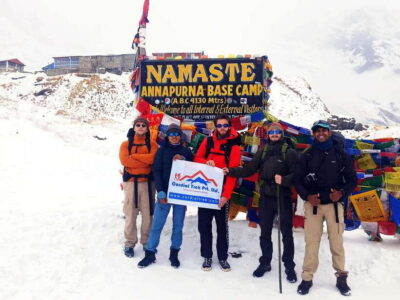
Annapurna Base Camp is the prize here: at 4,130 meters, you reach a broad mountain sanctuary ringed by Annapurna I, Annapurna South, Hiunchuli, Machhapuchare, and other high peaks. The route gives you a lot in one week, from Pokhara’s lakeside streets to Gurung villages, terraced hills, bamboo woods, and cold alpine country.
I like the cultural start in Ghandruk, where you can see Gurung homes, customs, museums, and mountain life before the trail gets high. I also like the practical package: guide, permits, guesthouse lodging, hotel transfers, and road transport are included in the $435 price. The main caution is the pace. Several walking days run about six or seven hours, and the rise to 4,130 meters calls for solid fitness and sensible pacing.
Key points before you book
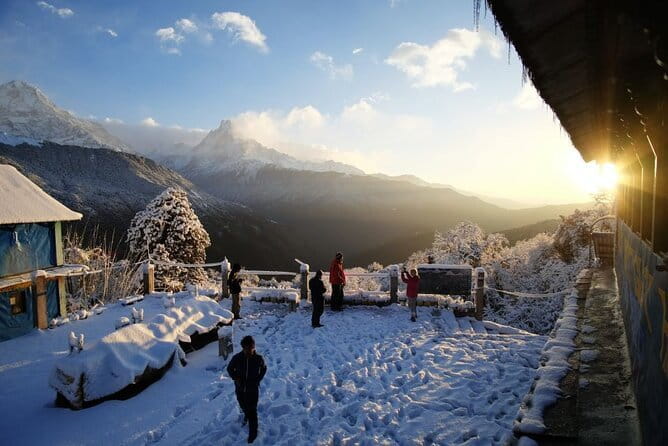
- Ghandruk gives the trek a human beginning: Meet the Gurung culture, mountain villages, and views before entering the high trail.
- The route reaches 4,130 meters: Annapurna Base Camp is the high point, with Machhapuchhare Base Camp at about 3,900 meters.
- Seven days means a brisk schedule: Walking days commonly last six or seven hours, with a four-hour road journey back to Pokhara.
- The package covers the main essentials: Hotel pickup and drop-off, shared bus or jeep transfers, permits, TIMS card, guide, and guesthouse accommodation are included.
- Guides named in guest feedback include Ram and Krishna: Krishna is specifically praised for helping with the ABC trek, while Ram is noted for support and sunrise views.
- The tour is private, but road transfers are shared: Your trekking group participates privately, while some transport is by shared vehicle.
What the $435 price really gets you
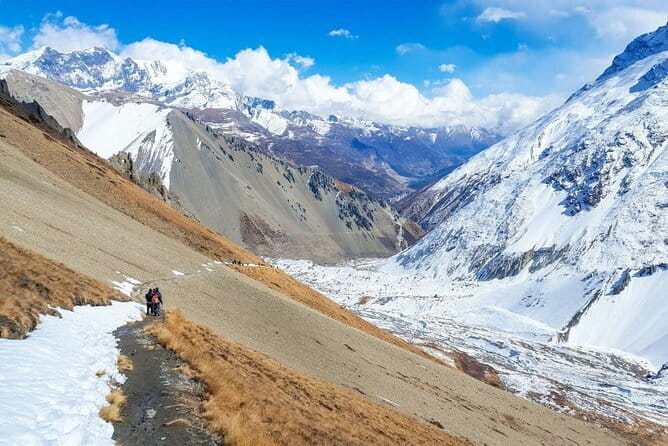
At $435 per person, this is a useful package for someone who wants the main arrangements handled before setting foot on the trail. The price includes hotel pickup and drop-off, round-trip transfers by shared bus or jeep, trekking permits, a TIMS card, an English-speaking guide, and guesthouse accommodation.
That matters in Nepal. The route has several road connections, and the trek requires permits and registration. Having those pieces arranged saves you from sorting them out separately in Pokhara. The package also reduces the chance of missing a transfer point while moving between road ends and walking sections.
The word shared is important. This is described as a private activity for your own group, but the bus or jeep transfers are shared. If you want a private vehicle for every road section, ask before booking.
Personal expenses are not included. Gratitude, meaning tips, is also excluded, so keep room in your budget for meals, drinks, showers, snacks, and a tip for the guide and support staff if their service suits you. The exact accommodation standard and meal arrangements are not specified, so ask for those details before paying.
More Annapurna Base Camp Treks in Pokhara
- Kathmandu/Pokhara: 5-Day Annapurna Base Camp (ABC) Trek
★ 4.9 · 72 reviews - Private 7 – Day Annapurna Base Camp Trekking
★ 5.0 · 50 reviews - Annapurna Base Camp Trek (8 days)
★ 5.0 · 45 reviews
Day 1: Pokhara to Ghandruk through the foothills
The first day combines road travel and a long introduction to the trail. You leave Pokhara for Kyu Mi Danda by way of Nayapul and Birethati, with the road becoming unpaved before the shared jeep connection toward Ghandruk.
This is not a quiet luxury transfer. Nepal’s mountain roads can be rough, and the shared jeep is part of the practical adventure. The benefit is that you reach a famous trail village without spending extra time on a longer approach walk.
Ghandruk is one of the most important stops on the route. It is a large Gurung village where you can see local customs, a museum, traditional life, and views toward Annapurna South, Hiunchuli, Machhapuchare, Gangapurna, and Annapurna III.
The day is listed at about seven hours, including the road and walking arrangements. That makes it a full opening day, but the payoff is immediate. You start seeing the Annapurna Himalayas instead of waiting until the final summit area.
I would treat Ghandruk as more than an overnight stop. Take time to look around, learn about Gurung life, and enjoy the changing views. The village gives the trek a cultural base, rather than turning it into seven days of mountains alone.
Day 2: Ghandruk to Upper Sinuwa via Chhomrong
The trail from Ghandruk to Upper Sinuwa is a demanding walking day of about seven hours, not counting lunch and tea breaks. You pass Kimrung Danda, the Kimrung River, and Chhomrong before reaching Sinuwa.
The route changes often. You see forests, river corridors, steep hills, and village scenery, with the Annapurna range appearing through the route. Chhomrong is a key settlement on the approach to the sanctuary, and it helps you understand how the trail links the lower villages to the high mountain area.
The word strenuous in the schedule deserves attention. This is not a gentle stroll after breakfast. You will need to manage climbs and descents, and the trail’s repeated changes in height can feel harder than a simple distance figure suggests.
I like this day because it brings together the human and natural sides of the trek. You move through Gurung country, but you also begin to feel the route narrowing toward the Modi River valley and the higher sanctuary.
Day 3: Bamboo, Dovan, and the route toward Annapurna Base Camp
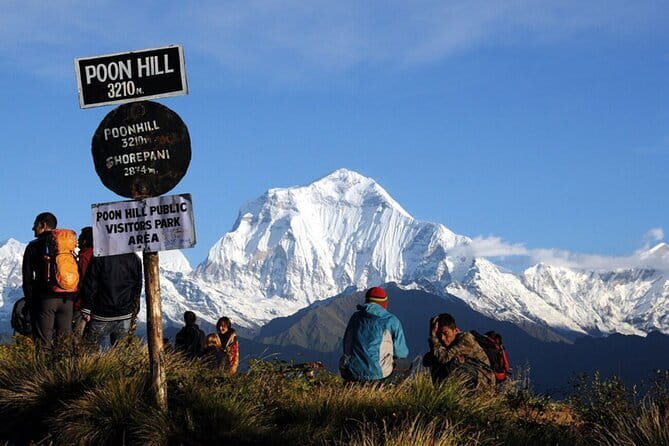
The third day heads deeper into the Annapurna Sanctuary area. The trail climbs through bamboo and rhododendron forest, passing places such as Bamboo and Dovan, with the Modi River valley providing much of the scenery.
The schedule describes this as a seven-hour walking day. Expect an uphill route and cooler air as you gain height. The forest is a major part of the experience here. Rather than seeing open peaks at every turn, you spend much of the day among trees, with mountain views opening and closing as the path bends.
This is a useful reminder that the ABC trek is not only about the final mountain panorama. The forest sections provide shade and a different mood from the exposed high country. Rhododendron and bamboo also mark the gradual change in vegetation as you climb.
There is a confusing point in the supplied schedule: Day 3 names Annapurna Base Camp as the stop, while Day 4 describes the actual climb through Machhapuchhre Base Camp to Annapurna Base Camp. You should confirm the intended overnight locations with Pokhara Adventure Nepal before departure. The detailed sequence clearly presents the high-point arrival on Day 4, after the approach through Bamboo, Dovan, and Deurali.
More Hiking Tours in Pokhara
- Poon hill Trek 3 days
★ 5.0 · 176 reviews - Trekking in Annapurna/Langtang/Everest/Upper Mustang regions
★ 5.0 · 161 reviews - Pokhara: 4-Day Ghorepani, Poonhill & Ghandruk Mountain Trek
★ 5.0 · 132 reviews - Ghorepani – Poon Hill Trek 3N-4D
★ 5.0 · 125 reviews
Day 4: Machhapuchhre Base Camp and Annapurna Sanctuary
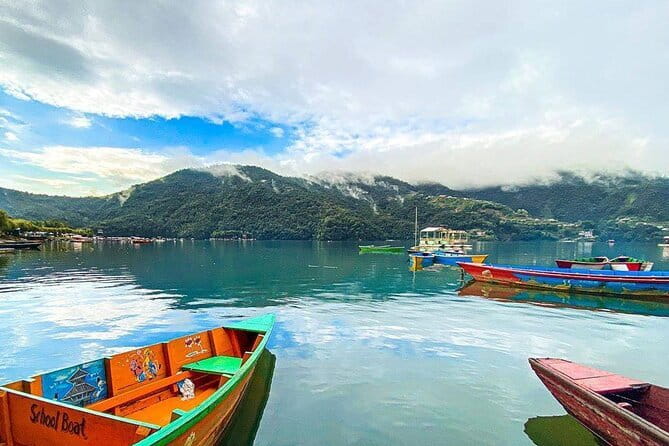
This is the trek’s main mountain day. You climb to Machhapuchhre Base Camp, located at about 3,900 meters, then continue roughly 730 meters higher to Annapurna Base Camp at 4,130 meters.
Machhapuchhre, also called Fishtail, is the star of the first part of the climb. The route passes beneath its North Face before entering the Annapurna Sanctuary. From there, the trail continues over grassy higher ground toward the base camp.
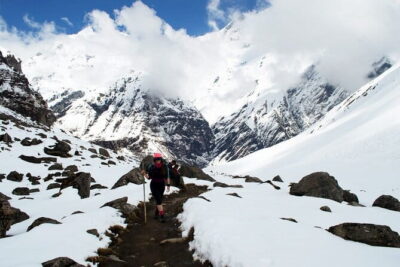
The final setting is the reason many people choose this trek. Annapurna Base Camp sits inside a mountain bowl, with high peaks surrounding the sanctuary. Annapurna I is part of the view, along with Annapurna South, Hiunchuli, Machhapuchare, and other peaks named along the route.
The day is listed at about six hours, but altitude changes the meaning of time. You may walk for fewer hours than on the previous day and still find the effort greater. The air is thinner, the trail is higher, and the climb from Machhapuchhre Base Camp to ABC is substantial.
Move slowly. Drink regularly, follow your guide’s advice, and do not treat the base camp arrival as a race. The package is not designed around a technical climb, but it does require a good level of fitness and comfort with sustained uphill walking.
The descriptions mention clear mountain views and sunrise, and the timing can make a major difference to what you see. Exact sunrise arrangements are not supplied, so ask your guide how the morning is handled if that matters to you. Guides Ram and Krishna are named in guest feedback, with Krishna receiving particular praise for the ABC route and support.
Day 5: The long descent from ABC to Bamboo
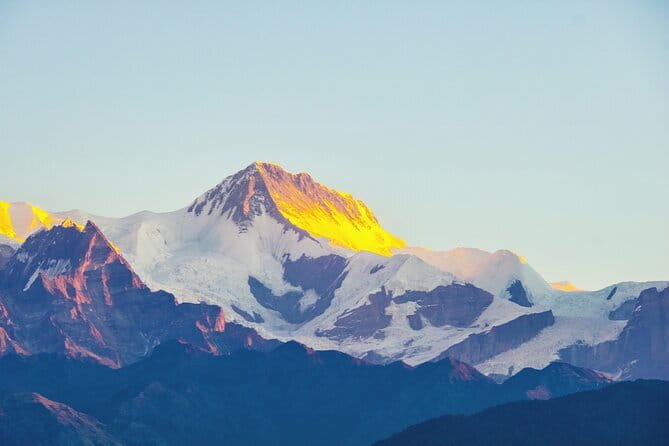
After the high point, you retrace the trail downhill through Deurali, Himalaya, and Dovan before reaching Bamboo. The day is about six hours.
Descending sounds easy until you spend hours stepping down uneven ground. Knees and ankles often notice the downhill more than the lungs notice the climb, so trekking poles, careful foot placement, and a steady pace can help. The schedule itself advises walking carefully.
The route gradually returns you to forest and lower elevations. That change can feel welcome after the exposed cold of the sanctuary. Bamboo is also presented as a place for a hot shower, which may be one of the most appreciated comforts of the whole week.
This is not a sightseeing day in the same way as the ABC arrival. It is a recovery and transition day. You have time to think back over the mountain bowl while moving into a greener setting.
Day 6: Bamboo to Jhinu Danda
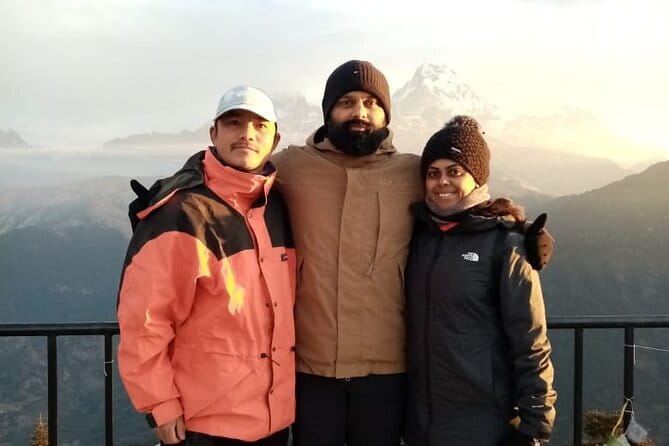
The sixth day covers about six hours and includes several changes in direction and height. You climb briefly to Khuldi Ghar, descend through forest to Sinuwa Danda, drop to the Chomrong Khola, cross a bridge, and climb toward Chomrong for lunch.
After Chomrong, the trail rises again to the top of the ridge before descending to Jhinu Danda. The pattern is classic for this part of Nepal: down to a river, up to a village, then down again.
Jhinu Danda is the final mountain stop before the road journey back to Pokhara. The supplied details do not specify activities or facilities beyond the overnight stay, so I would not assume that a particular attraction is included. The value of this day is the return through forest and villages, plus the sense that the high section is now behind you.
You should still take it seriously. Repeated short climbs can be tiring after the ABC ascent and long descent. Keep your daypack light and save energy for the final trail section.
Day 7: Jhinu Danda to Pokhara Lakeside
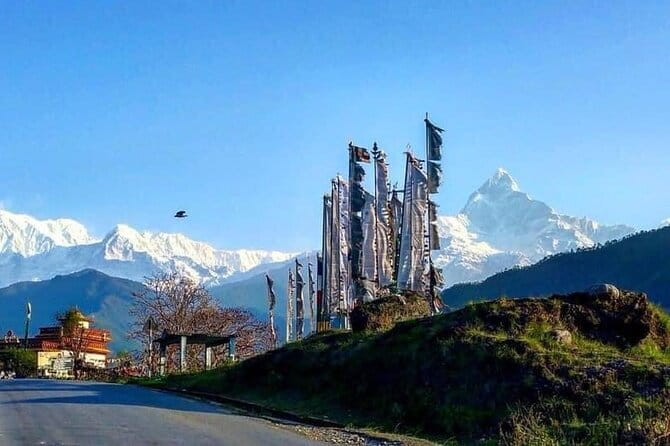
The last walking section is short and downhill, crossing a long suspension bridge to Samrung Khola. From there, you catch a local jeep for the drive back to Pokhara, listed at about four hours.
The road passes through Kimrung village, Syauli Bazaar, Birethati, Nayapul, Kande, and Naudanda before reaching Pokhara. This is a scenic return, but it is also a road journey on mountain routes, so the four-hour estimate matters. You should not plan a tight onward connection or flight immediately afterward.
The tour ends at Pokhara Lakeside. That is convenient if your hotel is in the lakeside area, though the exact drop-off arrangement should be confirmed. Hotel pickup and drop-off are included, but the itinerary specifically identifies Pokhara Lakeside as the end point.
The scenery changes every day
The strength of this route is variety. You begin among lower mountain villages and terraced hills, pass through subtropical forest, then enter bamboo and rhododendron woodland before reaching alpine terrain and the Annapurna Sanctuary.
The mountain views also change with your position. From Ghandruk, you look toward several major peaks across the foothills. Near Machhapuchhre Base Camp, Fishtail becomes a powerful presence. At ABC, the mountains surround you at close range.
The forest sections should not be treated as filler. They provide the route’s shade, rivers, changing plant life, and links between the Gurung communities and the high peaks. If you expect nonstop open panoramas, you may find the wooded sections slower. If you enjoy a route that changes character, this is a strong point.
Culture, villages, and the human side of the route
Ghandruk provides the clearest cultural stop, with Gurung customs, a museum, local lifestyle, and village scenery. The route also passes through Chhomrong and other communities where the trail is part of daily mountain life.
The package gives you an English-speaking guide, which is valuable here. A guide can help connect the places you pass with local culture and can also help you manage the route’s demanding sections. The feedback names Ram and Krishna, with repeated praise for guide support. Krishna is specifically identified as a strong mountain guide for completing the ABC route.
The accommodation is in guesthouses. That tells you to expect practical mountain lodging rather than resort comfort. Room quality, food, and transport are praised in the supplied comments, but exact room types and meal inclusions are not stated. Ask what is covered each night, especially if you have dietary needs or want private rooms.
Fitness, altitude, and practical concerns
You should have a moderate physical fitness level at minimum. The schedule includes several six or seven-hour walking days, steep sections, repeated climbs and descents, and a maximum elevation of 4,130 meters.
The itinerary moves quickly for a seven-day ABC trip. It does not list a separate acclimatization day. That does not mean the trek cannot work, but it does mean you should prepare for consecutive walking days and discuss pacing with the guide.
The tour is not suitable for wheelchair users because the route requires walking on mountain trails. A passport copy and passport-size photo are required before the trek so the permits can be prepared.
Bring only what you need for the trail, but the exact packing list is not provided. At a minimum, plan for changing temperatures, long walking days, and the possibility of needing personal snacks and drinks. Since personal expenses are excluded, carry money for those items and for gratitude.
Is this trek good value?
The price makes the tour attractive for people who want a guided ABC experience without arranging each part independently. Permits, TIMS registration, accommodation, road transfers, hotel transport, and an English-speaking guide are all included.
The value depends on what you expect from the lodging and transport. Shared vehicles keep the cost down, and the tour is not presented as a luxury trek. You are paying for access, organization, and guiding, not polished hotels or private road transport at every stage.
The private-group format is useful if you want your own party on the trek rather than joining a large walking group. Still, shared bus and jeep transfers mean the road portions may include other passengers.
The strongest praise centers on three things: helpful guides, mountain views, and transport that works as planned. Comments also point to satisfactory rooms and food. The feedback is brief, so I would use it as reassurance about the basics, not as proof of a high-end experience.
Should you book Annapurna Base Camp in seven days?
Book this trek if you want the classic Annapurna Base Camp route, have limited time in Nepal, and value having permits, guiding, guesthouses, and transfers arranged together. It suits fit walkers who are comfortable with long days and a quick rise toward 4,130 meters.
Think twice if you want a slow schedule, a dedicated acclimatization day, private vehicles throughout, or detailed information about meals and rooms before booking. Also confirm the Day 3 and Day 4 sequence, since the supplied schedule describes the ABC arrival in two different places.
At $435, this is a practical, strongly praised package for a brisk seven-day adventure. I would book it after confirming the overnight plan, what guesthouse rooms include, and the exact pickup and return details.
FAQ
How long is the Annapurna Base Camp trek?
The experience lasts approximately seven days, including road transfers between Pokhara and the trail. Walking days are generally listed at six or seven hours.
What is the highest point reached?
The trek reaches Annapurna Base Camp at 4,130 meters above sea level. Machhapuchhre Base Camp is reached at about 3,900 meters.
Is hotel pickup and drop-off included?
Yes. Hotel pickup and drop-off are included in the tour package.
Are permits and the TIMS card included?
Yes. The package includes the trekking permit and TIMS card. A passport copy and passport-size photo are required before the trek so the permits can be prepared.
Is transport private?
The trekking activity is private, meaning only your group participates. Road transfers are by shared bus or jeep, so the transport itself is not fully private.
What kind of accommodation is provided?
Accommodation is provided in guesthouses. The supplied details do not specify room types or meal arrangements, so you should confirm those points before booking.
Is the trek suitable for wheelchair users?
No. The experience requires walking on mountain trails and is not recommended for wheelchair users.
Can I cancel for a full refund?
Yes, if you cancel at least 24 hours before the experience start time. Cancellations or changes made less than 24 hours before the start are not accepted for a refund.
More 7-Day Experiences in Pokhara
- Pokhara: 7 Day Annapurna Base Camp Trek
★ 4.9 · 38 reviews - Annapurna Base Camp Trek from Pokhara 7 Days
★ 5.0 · 19 reviews - 7-Day Trek to Annapurna Base Camp from Pokhara
★ 5.0 · 12 reviews - Pokhara: 7-Day Annapurna Base Camp Trek & Natural Hot Spring
★ 5.0 · 11 reviews
Recently added around Pokhara
- Paragliding in Pokhara★ 5.0 · 3 reviews
- Pokhara: 5-Day Annapurna Base Camp Trek with Hot Spring★ 5.0 · 3 reviews
- Pokhara:4-Day Ghorepani Poon Hill Guided Trek via Ghandruk★ 5.0 · 3 reviews
- Pokhara: 7-Day Annapurna Base Camp Trek via Ghandruk★ 4.3 · 3 reviews
- Peace & Panorama: Stupa and Pumdikot Scenic Drive Tour★ 3.6 · 3 reviews
- Beautiful Sarankot Sunrise with Full Day Sightseeing in Pokhara★ 4.5 · 3 reviews
- 3 Day Australian Camp Dhampus Ghandruk Easy Trek in Pokhara★ 3.5 · 3 reviews
- Overnight Dhampus Australian Camp Easy Hiking from Pokhara★ 5.0 · 3 reviews
Other Annapurna Base Camp Treks worth a look
Kathmandu to Annapurna Base Camp (ABC) 5-Day Trek
Read our review →